
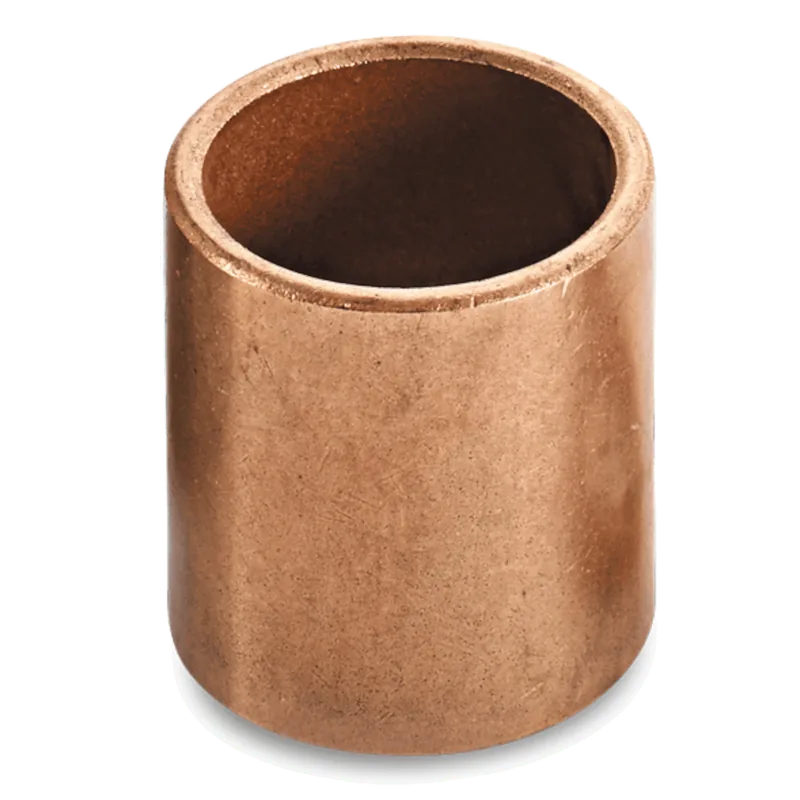
Cylindrical Bronze Bushings BP25 — 02 to 15
Oil-impregnated BP25 sintered bronze cylindrical bushings, bore Ø2–15 mm, 97 variants. Maintenance-free, self-lubricating plain bearings to DIN 1850 / ISO 2795.
- Material
- BP25 Bronze
- Family
- Cylindrical Bushings
- References
- 97 available sizes
- Supply
- Standard sizes and project quantities
Choose your size
97 original dimensional references are available for this product group.
Selected reference: Ø Int. 2 - Ø Ext. 5 - Long. 2
Request this size →The BP25 Cylindrical Bronze Bushings series covers the small-bore end of Bushingo's plain-bearing catalogue, spanning nominal bore diameters from Ø2 mm to Ø15 mm across 97 individual variants. Every bushing in the group is a straight, flangeless cylindrical sleeve pressed from BP25 oil-impregnated sintered bronze — a tin-bronze (nominally CuSn10) porous matrix whose interconnected pore network is vacuum-charged with lubricating oil, giving a genuinely maintenance-free, self-lubricating dry-running bearing.
The range runs from the compact Ø int. 2 – Ø ext. 5 – length 2 mm sleeve, with its 1.5 mm wall, up to the Ø int. 15 – Ø ext. 21 – length 32 mm size, which carries a 3.0 mm wall. Length-to-bore ratios across the family therefore fall roughly between 1:1 and 2:1 — the proportions typically specified for well-aligned, moderately loaded rotary and oscillating duty. Wall thicknesses follow the DIN 1850 dimensional pattern, so each variant press-fits into a standard reamed housing bore without special machining.
Because the lubricant is held within the bushing itself, these cylindrical bronze bearings need no grease nipple, oil hole or scheduled re-lubrication, making them a clean, quiet and cost-effective replacement for miniature ball bearings and machined solid-bronze bushes in high-volume assemblies.
How it works
BP25 sintered bronze is deliberately manufactured with roughly 20–25% interconnected porosity, and those voids are impregnated under vacuum with a low-viscosity mineral bearing oil. At rest the oil is held in the pores by surface tension. When the shaft turns, the combination of frictional heat — which lowers the oil's viscosity and makes it expand — and the hydrodynamic pressure generated in the converging gap draws a thin film of oil out of the pores onto the sliding surface, so the shaft effectively rides on a self-replenishing oil film rather than on dry metal.
When motion stops and the bearing cools, capillary action reabsorbs the oil back into the porous bronze, ready for the next start. This continuous exchange keeps the running coefficient of friction low — typically around 0.05–0.10 for this material class — and lets the bearing operate maintenance-free for the design life of most light-duty mechanisms, provided the impregnated oil is not washed out by solvents or driven off by excessive heat.
Technical characteristics
| Material | BP25 oil-impregnated sintered bronze (nominal CuSn10) |
|---|---|
| Reference standards | ISO 2795 / DIN 1850 sintered plain bushes |
| Bushing form | Cylindrical straight sleeve, flangeless |
| Bore range | Ø2 mm to Ø15 mm — 97 variants |
| Wall thickness | 1.5 mm to 3.0 mm across the range |
| Length-to-bore ratio | Approx. 1:1 to 2:1 (e.g. 2/2 up to 32/15 mm) |
| Interconnected porosity | ~20–25%, vacuum oil-impregnated |
| Typical coefficient of friction | ~0.05–0.10 running, self-lubricated |
| Typical PV limit | Up to ~1.8 N/mm²·m/s (material-class guidance, dry) |
| Typical operating temperature | Approx. −20 °C to +100 °C (oil-limited, material class) |
Typical applications
- Fractional-horsepower and micro DC motor end-shields
- Office and business machines — printers, scanners, shredders
- Domestic appliances such as mixers, fans, extractor hoods and small pumps
- Power-tool and garden-equipment gear trains
- Automotive comfort actuators (seat, mirror and HVAC flap drives)
- Small gearmotors and geared drive mechanisms
- Cooling and ventilation fan spindles
- Precision instruments and mechatronic linkages
- Guide bushes for light oscillating levers and pivots
- Toys, models and hobby drive assemblies
Installation & fitting
These cylindrical bushings are retained by an interference fit in the housing, so no adhesive or additional locking is normally required. Handle them clean and dry — never wipe the bore with solvent, which strips the impregnated oil.
- Bore the housing to an H7 tolerance and add a 0.5–1 mm lead-in chamfer so the bushing starts squarely.
- Press the bushing home with a smooth, polished arbor that bears on the full end face; avoid hammer blows, which distort the thin wall and burnish over the surface pores.
- Remember that the bronze wall contracts on pressing, so the finished running bore closes by a small amount — size it after fitting with a ball or plug. Never ream or machine the bore, as cutting smears metal across the pores and destroys the self-lubricating action.
- Use a ground shaft in the h6–f7 range with a surface finish of Ra ≤ 0.4 µm for the best oil-film performance.
- Keep solvents, hot degreasers and cutting fluids away from the bushing; if it is accidentally washed dry, re-impregnate it in warm bearing oil before use.
Selection guidance
Choose this BP25 cylindrical range when you need a compact, self-lubricating plain bearing for shafts between Ø2 and Ø15 mm and the housing can react the radial load through a simple straight bore. If the assembly must also take an axial thrust or locate against a shoulder, select the equivalent flanged BP25 bushing instead. Where duty is heavier — slow speeds under high load, frequent starts, or shock — the higher-strength FP20 sintered iron or SO16 alloy grades carry more load than sintered bronze; for larger shafts, step up to Bushingo's wider-bore cylindrical series. BP25 remains the default first choice wherever low friction, quiet running, corrosion resistance and maintenance-free operation matter more than peak load capacity.
Available references
97 original dimensional references are available for this product group.
Frequently asked questions
Do these bushings need greasing or oiling in service?
Can I ream or machine the bore to size after fitting?
What shaft tolerance and finish should I use?
How much does the bore close when the bushing is pressed in?
What loads, speeds and temperatures can BP25 handle?
How is a cylindrical bushing different from a flanged one?
Application-focused selection
Send dimensions, load, speed, temperature and environmental conditions for a technical review.
Request a quote ↗