
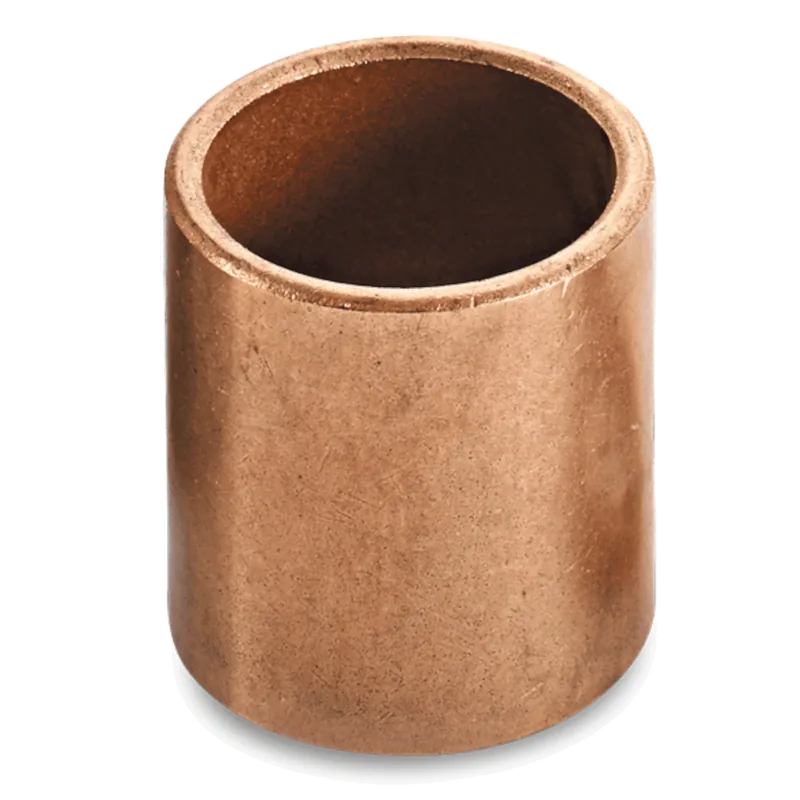
Cylindrical Bronze Bushings BP25 — 16 to 32
Oil-impregnated BP25 sintered bronze cylindrical bushings, bores Ø16–32 mm. Maintenance-free, self-lubricating, 85 press-fit variants to ISO 2795 / DIN 1850.
- Material
- BP25 Bronze
- Family
- Cylindrical Bushings
- References
- 85 available sizes
- Supply
- Standard sizes and project quantities
Choose your size
85 original dimensional references are available for this product group.
Selected reference: Ø Int. 16 - Ø Ext. 20 - Long. 16
Request this size →The Cylindrical Bronze Bushings BP25 — 16 to 32 range covers plain cylindrical (flangeless) sleeve bearings pressed from BP25 oil-impregnated sintered bronze, spanning bore diameters from Ø16 mm up to Ø32 mm across 85 individual variants. Each bush is a sintered-bronze sleeve whose interconnected pore network is vacuum-impregnated with lubricating oil, so the bearing carries its own lubricant supply and runs without any external greasing or oiling system.
The two reference sizes in this group illustrate the geometric span: the smallest sample is Ø Int. 16 × Ø Ext. 20 × Length 16 mm — a compact 2 mm nominal wall with a length-to-bore ratio of 1.0 — while the largest sample reaches Ø Int. 32 × Ø Ext. 40 × Length 50 mm, a 4 mm wall with a length-to-bore ratio of roughly 1.56. This progression of wall thickness and bearing length lets designers match projected bearing area to the shaft they are supporting, from short compact pivots to longer, more heavily guided journals.
All variants follow the standard cylindrical sintered-bush form covered by ISO 2795 and DIN 1850, making them a direct maintenance-free substitute for machined bronze or plain steel-backed bushes in equipment where relubrication is impractical, undesirable, or simply uneconomic over the service life of the machine.
How it works
BP25 sintered bronze is produced by compacting and sintering bronze powder, which leaves a controlled network of interconnected pores — typically around 20–25% of the material volume — that is then vacuum/pressure-impregnated with lubricating oil. In service, the oil is held in this porous matrix by capillary action. When the shaft rotates, frictional heat and the hydrodynamic action of the moving journal draw a thin film of oil out of the pores and onto the bearing surface; when motion stops and the bush cools, capillary forces draw the oil back into the porosity. This continuous, reversible exchange forms a self-replenishing lubricating film and is what makes the bearing effectively maintenance-free over its normal working life.
Because the lubricant is stored within the wall of the bush, thicker-walled variants in this range (such as the 4 mm wall of the Ø32 × Ø40 size) hold a larger oil reservoir than the thin-walled small sizes, while longer bushes distribute the shaft load over greater projected area and generate a more stable film. The mechanism performs best at moderate sliding speeds and steady loads, where the pumping action stays in balance; very slow oscillation, frequent stop-start duty, or shock loading reduce hydrodynamic pumping and rely more heavily on the boundary-lubrication reserve held in the pores.
Technical characteristics
| Material | BP25 oil-impregnated sintered bronze (Metafram-type) |
|---|---|
| Family | Cylindrical (flangeless) plain bushings |
| Bore diameter range (Ø Int.) | 16 to 32 mm |
| Outside diameter range (Ø Ext.) | 20 to 40 mm (per matched variant) |
| Length range | 16 to 50 mm |
| Nominal wall thickness | 2 mm (Ø16/20) to 4 mm (Ø32/40) |
| Number of variants | 85 |
| Interconnected porosity | Typically ~20–25% by volume, oil-filled |
| Reference standards | ISO 2795 / DIN 1850 sintered bushes |
| Lubrication | Self-lubricating, maintenance-free (no external greasing) |
Typical applications
- Electric motor and gearmotor end-shield bearings
- Pumps, fans and blower shaft supports
- Household and power-tool gearbox pivots
- Automotive auxiliaries: seat mechanisms, wipers, HVAC actuators
- Office and precision equipment: printers, copiers, ticketing machines
- Agricultural and garden machinery linkages and rollers
- Conveyor idlers, guide rollers and tensioner arms
- General industrial linkages, levers and hinge pivots requiring dry running
Installation & fitting
Sintered bushings are normally retained by an interference (press) fit into a rigid housing; the housing bore effectively sizes the bush, since a correctly toleranced press fit closes the sintered sleeve down to its final running clearance. Observe the following:
- Use a properly aligned arbor press with a piloted mandrel that bears on the full end face of the bush — never hammer directly on the sintered material, which can chip pores closed or fracture the wall.
- Provide a lead-in chamfer on the housing bore and keep the bush square to the bore to avoid cocking during entry; the shorter 16 mm-length variants are more prone to tilting than the longer 50 mm sizes.
- Do not ream or machine the bore after fitting where avoidable — cutting smears metal over the surface pores and can seal the oil paths. If sizing is unavoidable, use a burnishing/ball-sizing tool rather than a cutting reamer to preserve porosity and set the final bore.
- Check running clearance after fitting against the intended shaft; the press fit will have reduced the free inside diameter.
- The bushes are supplied pre-impregnated — handle with clean gloves, avoid degreasing solvents that would strip the stored oil, and store in clean, dry conditions until use.
Selection guidance
Choose a variant from this BP25 16–32 group when you need a compact, flangeless, maintenance-free journal bearing in the medium bore range and the load is spread axially rather than taken as a thrust face. Pick a shorter length (for example the Ø16 × Ø20 × 16 mm size) for space-constrained pivots and light guiding, and a longer length (such as the Ø32 × Ø40 × 50 mm size) where a higher length-to-diameter ratio, greater projected bearing area and a larger internal oil reservoir are wanted for steadier running. If your design needs an integral thrust shoulder to locate the shaft axially or to react end loads, select a flanged sintered bush instead of these cylindrical types. Where duty involves higher temperatures, heavier or shock loading, or a corrosive/abrasive environment, consider the sintered-iron (FP20) or alloy (SO16) material families rather than BP25 bronze. Confirm the exact bore, outside diameter and length against your housing and shaft before ordering, and specify the running clearance required for your speed and temperature.
Available references
85 original dimensional references are available for this product group.
Frequently asked questions
Do BP25 bushings need greasing or oiling in service?
What shaft and housing tolerances should I use?
Can these cylindrical bushes take axial thrust loads?
What is the difference between the 16 mm and 50 mm long variants?
Are the load, PV and temperature limits certified for these SKUs?
Can I ream or machine the bore to final size after pressing?
Application-focused selection
Send dimensions, load, speed, temperature and environmental conditions for a technical review.
Request a quote ↗