
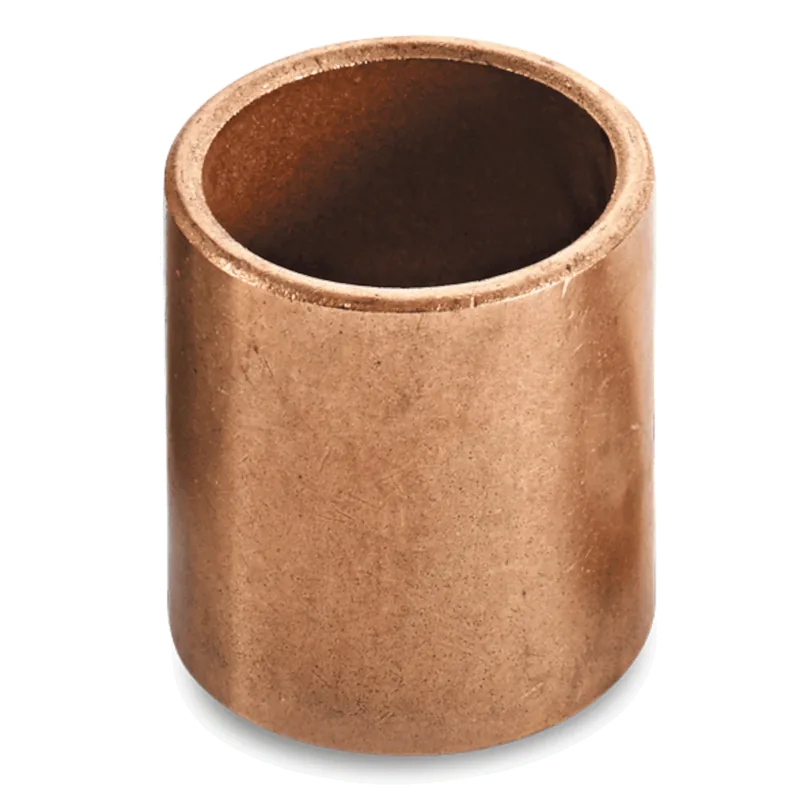
Cylindrical Bronze Bushings BP25 — 35 to 125
Oil-impregnated BP25 sintered bronze cylindrical bushings, Ø35–125mm bore, 66 sizes. Maintenance-free, self-lubricating plain bearings to ISO 2795/DIN 1850.
- Material
- BP25 Bronze
- Family
- Cylindrical Bushings
- References
- 66 available sizes
- Supply
- Standard sizes and project quantities
Choose your size
66 original dimensional references are available for this product group.
Selected reference: Ø Int. 35 - Ø Ext. 44 - Long. 22
Request this size →The Cylindrical Bronze Bushings BP25 range is a family of 66 straight, unflanged sleeve bearings produced from oil-impregnated sintered bronze. It spans a broad medium-to-large bore band, from a compact Ø35 mm bore in a Ø44 mm body only 22 mm long, up to a substantial Ø125 mm bore in a Ø150 mm body 120 mm long, giving designers one consistent material specification across widely differing shaft sizes.
Every bush in the group is made from BP25, a tin-bronze (nominally CuSn10-type) sintered structure whose interconnected porosity is vacuum-impregnated with bearing oil. Wall sections scale with bore, from a 4.5 mm wall on the 35 × 44 size to a 12.5 mm wall on the 125 × 150 size, so the parts stay dimensionally proportioned and press-fit reliably into a matching housing bore. Dimensions follow established sintered-bush practice in line with ISO 2795 and DIN 1850.
Because the lubricant is stored inside the bearing wall rather than supplied from outside, these cylindrical bushings run maintenance-free. They are well suited to sealed, inaccessible or high-cycle assemblies where regreasing is impractical and where a clean, oil-free installation is preferred.
How it works
Oil-impregnated sintered bronze acts as a self-contained hydrodynamic bearing. During sintering the bronze powder is consolidated but deliberately left with roughly 20–25% interconnected porosity by volume — a fine capillary network that is then vacuum-filled with lubricating oil. At rest, the oil is held inside the wall by surface tension. When the shaft begins to turn, frictional heat and the pressure wedge under the rotating journal draw oil out of the pores to the bearing surface, where it forms a load-carrying film that separates the metal faces.
As the assembly slows and cools, that oil is reabsorbed into the porous structure by capillary action, ready for the next cycle. This continuous internal exchange delivers long, lubricant-free service without external oiling or greasing. Sliding speed is the main driver of film formation, so the mechanism is most effective on steady rotary duties; very slow or heavily shock-loaded motion benefits from the thicker wall sections available at the upper end of this range.
Technical characteristics
| Material | BP25 oil-impregnated sintered bronze (CuSn10-type) |
|---|---|
| Bearing type | Cylindrical straight bush, unflanged |
| Bore range (Ø Int.) | 35–125 mm |
| Outside diameter (Ø Ext.) | 44–150 mm |
| Length range | 22–120 mm |
| Wall thickness | 4.5 mm (35×44) to 12.5 mm (125×150) |
| Sizes in family | 66 variants |
| Interconnected porosity | ≈20–25% by volume, oil-filled |
| Lubrication | Self-lubricating, maintenance-free (no external greasing) |
| Reference standards | ISO 2795, DIN 1850 (sintered bush practice) |
Typical applications
- Electric motor and gearmotor end bearings
- Household appliance drives such as pumps, fans and washing-machine assemblies
- Automotive ancillaries including window lifts, seat adjusters and wiper linkages
- Pump and blower shaft supports
- Office equipment, printers and vending mechanisms
- Agricultural and garden-machinery pivots and rollers
- Conveyor rollers and belt idlers
- Hydraulic and pneumatic actuator guide bushes
Installation & fitting
Sintered bronze bushings are installed by press-fit and must not be reamed after mounting, because cutting tools smear the surface and close the oil-bearing pores that make the bearing work.
- Machine the housing bore to a clean H7 tolerance and add a small lead-in chamfer so the bush starts square.
- Press with a piloted, polished mandrel that bears on the full end face; never hammer directly on the sintered material.
- Allow for bore close-in: the interference fit reduces the inner diameter slightly after pressing. Where a precise running clearance is critical, finish the bore with a ball-sizing or burnishing tool rather than a reamer or boring bar.
- Keep the shaft journal smooth — a ground finish is ideal — to preserve the oil film and minimise wear.
- Handle clean and dry; avoid solvents, degreasers or hot washing that would leach the impregnated oil out of the wall.
- On the longer sizes in this range (lengths up to 120 mm), press progressively and check alignment so the bush is not cocked in a deep bore.
Selection guidance
Choose this BP25 range when you need cylindrical (unflanged) bearings for medium-to-large shafts in the Ø35–125 mm band and want the higher sliding-speed capability, quiet running and corrosion resistance of sintered bronze. Bronze suits continuous rotary duty at moderate loads; if the bearing must also carry axial thrust or locate a component endwise, select a flanged BP25 bush instead. Where cost is the priority and speeds are low with higher static loads, a sintered iron (FP20) equivalent may be preferable, while SO16 alloy or Metagliss composite plates address higher-temperature or flat-sliding requirements. Within the 66 variants, match the bore to your shaft first, then confirm the housing can accept the corresponding outside diameter and length.
Available references
66 original dimensional references are available for this product group.
Frequently asked questions
Do these bushings need greasing or an external oil supply?
What housing and shaft fits should I use?
Can I ream or bore the bushing to final size?
How is BP25 bronze different from FP20 sintered iron?
What operating temperature can they handle?
Which of the 66 sizes should I pick?
Application-focused selection
Send dimensions, load, speed, temperature and environmental conditions for a technical review.
Request a quote ↗