
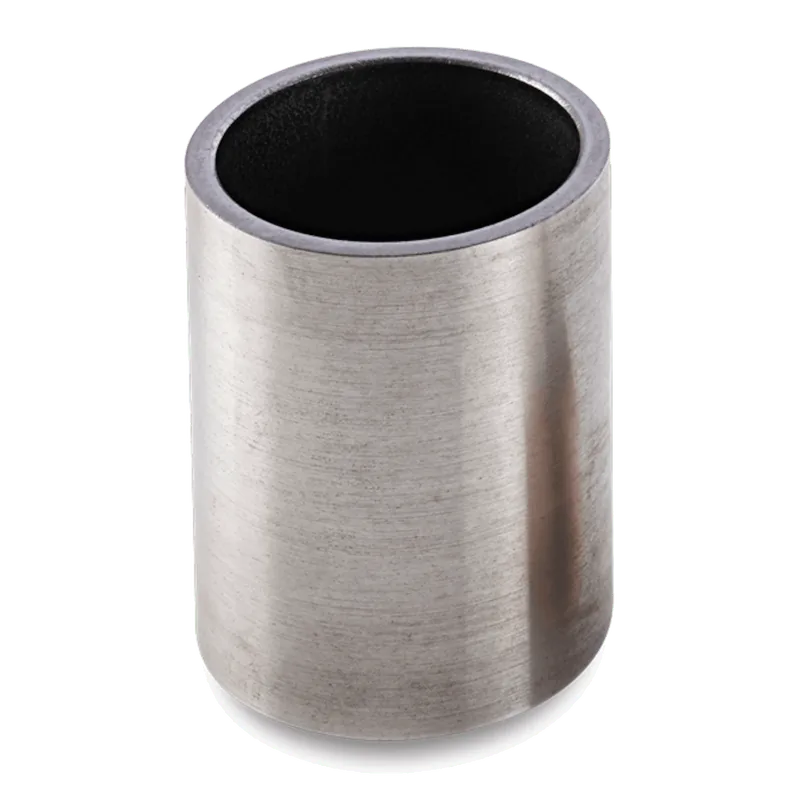
Cylindrical Iron Bushings FP20
Oil-impregnated FP20 sintered iron cylindrical bushings, 91 sizes from Ø3 to Ø100mm bore. Maintenance-free, self-lubricating plain bearings to ISO 2795.
- Material
- FP20 Iron
- Family
- Cylindrical Bushings
- References
- 91 available sizes
- Supply
- Standard sizes and project quantities
Choose your size
91 original dimensional references are available for this product group.
Selected reference: Ø Int. 3 - Ø Ext. 6 - Long. 4
Request this size →The Cylindrical Iron Bushings FP20 range is a family of straight, unflanged plain bearings pressed from oil-impregnated FP20 sintered iron. As a Metafram-type sintered material, FP20 is produced by compacting and sintering an iron powder matrix that retains a network of interconnected pores; these pores are then vacuum-impregnated with lubricating oil, giving a bearing that carries its own reservoir of lubricant and runs maintenance-free. The plain cylindrical geometry — a simple sleeve with no flange or shoulder — is the workhorse bushing form, radially loaded and located entirely by the interference fit in its housing.
This range spans 91 discrete sizes, from a miniature Ø Int. 3 - Ø Ext. 6 - Long. 4 bush up to a substantial Ø Int. 100 - Ø Ext. 120 - Long. 120 sleeve. Across that span the wall thickness grows from just 1.5 mm on the smallest size to a full 10 mm on the largest, and length-to-bore ratios sit close to unity (roughly 1.3:1 on the small end, 1.2:1 on the large end) — proportions that keep the shaft well supported without over-constraining alignment. Bore, outside diameter and length are held to the dimensional practice of ISO 2795 / DIN 1850 for sintered bushes.
FP20 sintered iron is the economical, hard-matrix alternative to sintered bronze. Its higher intrinsic hardness suits it to steady, low-to-moderate speed duty and to comparatively high static and intermittent loads, particularly against hardened or ground steel shafts. The result is a low-cost, self-contained bearing that eliminates greasing, wicks and drip-feed systems from the assembly.
How it works
FP20 works as a self-lubricating bearing because roughly 20-25% of its volume is interconnected porosity flooded with oil. At rest, capillary action holds the oil within the pore network. When the shaft turns, two effects release it: frictional heat expands the oil more than the surrounding iron matrix, and the converging gap between shaft and bore generates a local hydrodynamic pressure that draws lubricant out of the pores at the load zone. A thin film is pumped onto the sliding surface, so the shaft rides largely on oil rather than on dry metal, keeping friction and wear low.
When rotation stops and the bush cools, the pressure and thermal drivers reverse and the same capillary action reabsorbs the surface oil back into the porosity — the reservoir is recharged for the next cycle. Because the lubricant is stored inside the bearing wall, no external oiling, greasing or maintenance is normally required over the service life, and the bush tolerates start-stop and oscillating duty where a fresh film must form repeatedly. The dense iron matrix gives FP20 its load-bearing hardness, while the retained pore volume sets how much oil is available to feed the interface.
Technical characteristics
| Material | FP20 oil-impregnated sintered iron (Metafram-type) |
|---|---|
| Bearing type | Cylindrical plain bush — straight, unflanged |
| Bore diameter (d) | Ø3 mm to Ø100 mm across the range |
| Outside diameter (D) | Ø6 mm to Ø120 mm across the range |
| Length (B) | 4 mm to 120 mm across the range |
| Wall thickness | 1.5 mm (Ø3×Ø6×4) up to 10 mm (Ø100×Ø120×120) |
| Stocked sizes | 91 variants in the family |
| Interconnected porosity | ~20-25% by volume, oil-filled (typical for the material class) |
| Lubrication | Self-lubricating, maintenance-free — no external greasing |
| Typical operating envelope | ≤ ~2 m/s sliding speed, PV up to ~1.8 N/mm²·m/s, roughly −20 to +80 °C (typical for sintered iron; not a certified rating for this SKU) |
Typical applications
- Fractional-horsepower and electric motor end bearings
- Domestic appliances — washing machines, fans, small pumps, kitchen machines
- Automotive ancillaries — seat and window mechanisms, wiper linkages, HVAC flap pivots
- Power tools and garden equipment gear trains
- Office and imaging equipment — printers, shredders, drive rollers
- Agricultural and material-handling machinery running at low speed
- Hinges, levers, pivots and oscillating linkages where a fresh oil film must reform each cycle
- Conveyor and idler rollers under steady radial load
- Cost-sensitive assemblies needing a maintenance-free bearing against a hardened steel shaft
Installation & fitting
These bushes are located solely by an interference (press) fit; the plain cylindrical form has no flange, so the housing carries all radial reaction and any axial retention is by the fit alone. Press into a clean, chamfered housing bore machined to roughly H7. Use a piloted arbor or insertion mandrel and press squarely — never drive the bush in with direct hammer blows, which brinell the sintered face and can distort the sleeve. A lead-in chamfer on both the housing mouth and the shaft end helps the bush enter without shaving.
- Bore closes after fitting: pressing into the housing shrinks the bore by a fraction of the diametral interference, so the finished running clearance must be planned around the after-fit bore, not the free size. Thicker-walled sizes at the large end (up to 10 mm wall) close less than the thin 1.5 mm miniature.
- Do not ream, hone or machine the bore: cutting smears the surface and closes the interconnected pores, destroying the self-lubricating action. If the bore must be brought back to size, use a polished ball or burnishing pin to size by displacement, which re-opens rather than closes the porosity.
- Shaft: a ground steel shaft, typically h6/g6 with a fine finish, gives the best film formation and life; harder, smoother shafts suit the iron matrix well.
- Handling: keep the bushes in their oiled packaging until fitting, and do not degrease or solvent-wash them — that strips the impregnated oil. Store flat and clean.
Selection guidance
Choose the FP20 sintered iron cylindrical bush when cost, hardness and steady low-to-moderate-speed load capacity matter more than top speed or corrosion resistance. Against a hardened or ground steel shaft, FP20 typically outperforms bronze on price and on resistance to high specific and intermittent loads, making it ideal for motors, appliances and oscillating linkages. Prefer BP25 sintered bronze instead where sliding speeds are higher, quieter running is required, or the environment is wet, corrosive, marine or food-adjacent — bronze tolerates faster surface speeds and resists corrosion better. Within the cylindrical family, use this straight bush wherever the bearing takes purely radial load and needs no thrust face; if the design must also locate a shaft axially or react a light thrust, select a flanged variant rather than a plain sleeve. With 91 sizes from Ø3 to Ø100 mm bore, this range covers everything from miniature instrument spindles to heavy Ø100 mm shafts from a single material class.
Available references
91 original dimensional references are available for this product group.
Frequently asked questions
Do these FP20 bushings need oiling or greasing in service?
How is FP20 sintered iron different from BP25 sintered bronze?
Can I ream or machine the bore to final size after fitting?
What housing and shaft tolerances should I use?
What speed, load and temperature can they handle?
Why a plain cylindrical bush rather than a flanged one?
Application-focused selection
Send dimensions, load, speed, temperature and environmental conditions for a technical review.
Request a quote ↗