
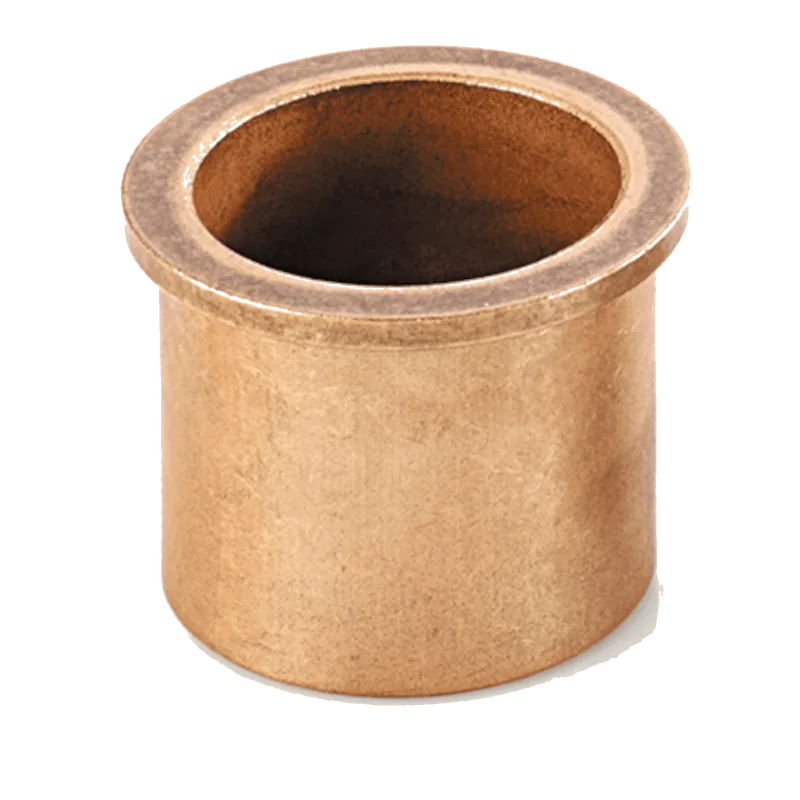
Flanged Bronze Bushings BP25 — C03 to C20
Flanged BP25 sintered bronze self-lubricating bushings, bore Ø3–Ø20 mm, 68 variants. Oil-impregnated, maintenance-free, with integral shoulder for axial location.
- Material
- BP25 Bronze
- Family
- Flanged Bushings
- References
- 68 available sizes
- Supply
- Standard sizes and project quantities
Choose your size
68 original dimensional references are available for this product group.
Selected reference: Ø Int. 3 - Ø Ext. 6 - Long. 4 - Ø Coll. 9 - Ép. 1,5
Request this size →The Flanged Bronze Bushings BP25 range covers 68 oil-impregnated sintered bronze plain bearings built around an integral collar (flange) that combines a cylindrical journal bearing with a thrust face in a single pressed and sintered part. Bores span from Ø3 mm up to Ø20 mm, with matching outside diameters from Ø6 mm to Ø26 mm and overall lengths from 4 mm to 32 mm, so a single family serves everything from miniature instrument spindles to small geared drive shafts.
The defining feature of this series is the shoulder itself. On the smallest C03 size the collar measures Ø9 mm over a Ø6 mm barrel, giving a 1.5 mm thick flange; on the largest C20 size the collar reaches Ø32 mm over a Ø26 mm barrel with a 3 mm thick flange. That projecting rim seats against a housing face to locate the bushing axially, carry light thrust loads, and act as a positive press-in stop, removing the need for a separate thrust washer or retaining step in many assemblies.
Like all BP25 components, these bushings are supplied ready to run: the interconnected porosity of the sintered bronze is vacuum-impregnated with lubricating oil, so the bearing lubricates itself in service and requires no external greasing, oil feed, or scheduled maintenance over its working life.
How it works
BP25 is a sintered bronze (nominally a tin-bronze composition) produced by compacting metal powder and sintering it below the melting point, which leaves a network of interconnected pores occupying roughly 20–25% of the volume. This pore network is vacuum-impregnated with lubricating oil, turning the whole bearing wall into an oil reservoir rather than relying on a surface film alone. When the shaft turns, frictional heat and the hydrodynamic pressure of the rotating journal draw oil out of the pores and into the running clearance; as the bearing cools and the shaft stops, capillary action wicks the oil back into the pore structure. The result is a self-replenishing lubricating film and genuinely maintenance-free dry running.
On a flanged bushing this mechanism operates on two surfaces at once. The cylindrical bore lubricates the radial journal contact, while the underside of the collar presents an oil-bearing thrust face against the housing, so light axial loads are carried on the same self-lubricating principle as the radial load. Sintered self-lubricating bushes to the ISO 2795 / DIN 1850 tradition perform best under continuous rotation at low-to-moderate surface speeds and steady loads, where the oil film is maintained most effectively.
Technical characteristics
| Material | BP25 oil-impregnated sintered bronze (tin-bronze type) |
|---|---|
| Bearing type | Flanged (collared) cylindrical plain bush |
| Bore diameter (Ø Int.) range | Ø3 to Ø20 mm |
| Outside diameter (Ø Ext.) range | Ø6 to Ø26 mm |
| Overall length (Long.) range | 4 to 32 mm |
| Collar / flange diameter (Ø Coll.) range | Ø9 to Ø32 mm |
| Flange thickness (Ép.) range | 1.5 to 3 mm |
| Variants in family | 68 dimensional sizes (C03 to C20) |
| Interconnected porosity | Typically ~20–25% by volume, oil-filled |
| Lubrication | Self-lubricating, vacuum oil-impregnated, maintenance-free |
Typical applications
- Miniature instrument and gearmotor spindles using the small C03-class sizes (Ø3 bore, Ø9 collar)
- Small geared drive and output shafts on the larger C20-class sizes (Ø20 bore, Ø32 collar)
- Positioning of shafts that need axial location without a separate thrust washer
- Domestic appliance motors, fans and pump rotors requiring quiet, lube-free running
- Office equipment, printers and paper-handling rollers
- Automotive auxiliary mechanisms such as seat, window and HVAC actuators
- Power tools and hand-held equipment with intermittent duty cycles
- General light-duty industrial linkages, pivots and lever assemblies
Installation & fitting
Flanged BP25 bushings are designed to be secured by an interference (press) fit into the housing bore, with the collar seating flat against the housing face to set depth and provide axial location. Because sintered bronze is relatively soft and its porosity must not be smeared closed, observe the following:
- Press the bush in axially using a flat-faced arbor or mandrel that bears on the collar face, applying force squarely to avoid cocking; never hammer directly on the bearing.
- Provide a lead-in chamfer on the housing bore and keep the housing square so the collar beds fully against the mating face.
- Do not ream, burnish or machine the bore after fitting unless a specific sized-tool method is used — cutting operations close the surface pores and destroy the self-lubricating action.
- Expect the bore to close slightly on press-in; the running clearance is set by the housing fit, so verify shaft fit on the installed part rather than the free bushing.
- Use a hardened, ground and smooth shaft as the counterface for best oil-film formation and longest life.
- Handle clean and dry — the impregnated oil is the lubricant, so avoid solvents that would leach it out of the pores.
Selection guidance
Choose a flanged BP25 bushing from this range when the shaft needs both radial support and axial location and you want to avoid adding a separate thrust washer or machining a locating shoulder into the housing. Within the 68-size range, match the bore to your shaft (Ø3 to Ø20 mm), confirm the housing can accept the outside diameter (Ø6 to Ø26 mm) and the seat depth suits the overall length (4 to 32 mm), then verify the collar diameter (Ø9 to Ø32 mm) clears surrounding features and that the flange thickness (1.5 to 3 mm) fits the axial gap. If your design has no axial thrust to react and the housing already locates the shaft, a plain straight (cylindrical) BP25 bush is more economical; step up to the flanged version specifically for the integral shoulder. For higher loads at low speed, or where oil must be excluded, consider the sintered iron (FP20) grade instead of bronze; for the smoothest quiet running at light loads, bronze BP25 is the standard choice.
Available references
68 original dimensional references are available for this product group.
Frequently asked questions
What does the collar (flange) on these bushings do?
Do these bushings need lubrication or greasing in service?
What shaft sizes does the C03 to C20 range cover?
Can I ream or machine the bore after pressing the bushing in?
How should the bushing be installed?
Are the load, speed and temperature ratings fixed for this SKU?
Application-focused selection
Send dimensions, load, speed, temperature and environmental conditions for a technical review.
Request a quote ↗