
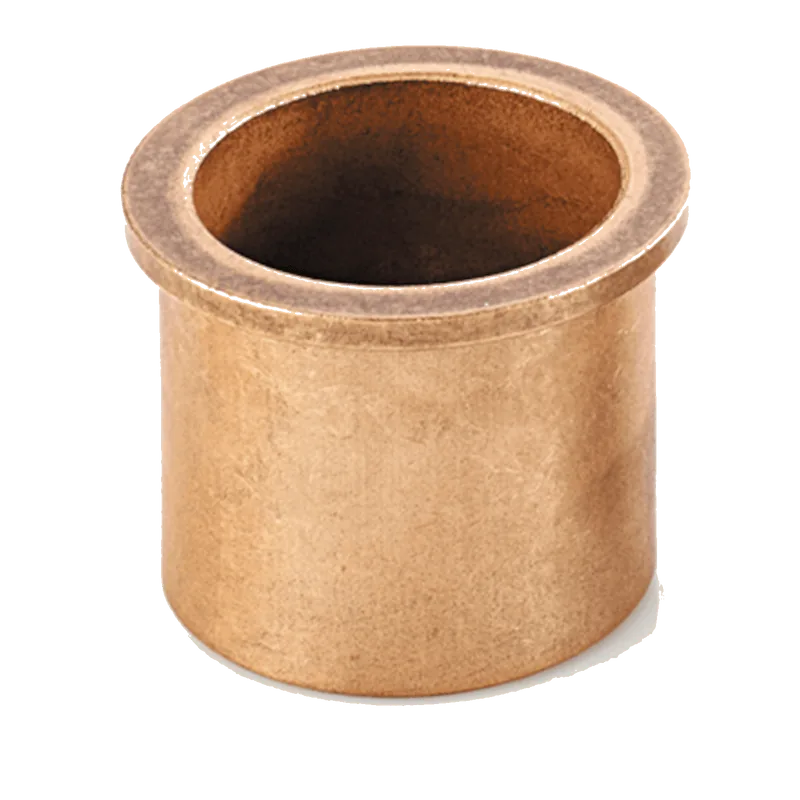
Flanged Bronze Bushings BP25 — C22 to C60
Oil-impregnated BP25 sintered bronze flanged bushings, bores 22–60 mm across 59 variants. Maintenance-free capillary lubrication for axial and radial loads.
- Material
- BP25 Bronze
- Family
- Flanged Bushings
- References
- 59 available sizes
- Supply
- Standard sizes and project quantities
Choose your size
59 original dimensional references are available for this product group.
Selected reference: Ø Int. 22 - Ø Ext. 27 - Long. 18 - Ø Coll. 32 - Ép. 2,5
Request this size →The Flanged Bronze Bushings BP25 series (references C22 to C60) covers a family of 59 oil-impregnated sintered bronze plain bearings built for combined radial and axial duty. The integral collar distinguishes this range from straight cylindrical bushes: the flange seats against a housing face or shaft shoulder, locating the bearing axially and carrying light thrust loads without a separate washer or shoulder machining. Bore diameters span 22 mm through 60 mm, with the smaller references such as Ø Int. 22 / Ø Ext. 27 / Long. 18 / Ø Coll. 32 / Ép. 2.5 mm suiting compact hinges, levers and pivots, while the largest references such as Ø Int. 60 / Ø Ext. 70 / Long. 60 / Ø Coll. 80 / Ép. 5 mm address heavier shafts in gearboxes, actuators and material-handling equipment.
Every bushing in the range is produced from BP25 sintered bronze — a pressed-and-sintered tin-bronze structure whose interconnected porosity is vacuum-impregnated with lubricating oil. In service the porous matrix acts as an internal oil reservoir, releasing lubricant to the sliding interface and reabsorbing it at rest, so the bearing runs maintenance-free and, within its rating, without external greasing. This makes the BP25 flanged range well suited to enclosed assemblies, sealed-for-life mechanisms and points that are difficult to relubricate after installation.
Wall thickness scales with size across the family, from roughly 2.5 mm on the Ø 22 bore reference to 5 mm on the Ø 60 bore reference, giving a robust cross-section for press-fitting and for supporting the flange. The collar diameter — for example 32 mm on the smallest listed size and 80 mm on the largest — sets the bearing surface available at the housing face. Selecting the correct reference from the 59 available is a matter of matching bore, outside diameter, length, collar diameter and flange thickness to the shaft and housing.
How it works
BP25 sintered bronze is manufactured by compacting bronze powder and sintering it below the melting point, which fuses the particles while deliberately leaving a network of interconnected pores — typically on the order of 20–25% of the volume in this class of material. After sintering, the bushings are vacuum-impregnated with a low-viscosity mineral oil that fills this porosity, so the finished part behaves as a self-contained bearing and lubricant reservoir in one component.
When the shaft rotates, frictional heat and the pressure of the developing hydrodynamic film draw oil out of the pores and into the running clearance, establishing a lubricating film between shaft and bore. As the material warms, the oil's thermal expansion assists this release; when motion stops and the bearing cools, capillary action pulls the oil back into the matrix. The result is a self-regulating cycle that keeps the interface lubricated during running and retains the oil at rest, allowing genuinely maintenance-free, dry-running operation within the typical limits of the material class. On a flanged bushing this same mechanism lubricates both the cylindrical bore and the flange face, so the collar can accept light axial sliding as well as locating the bearing.
Technical characteristics
| Material | BP25 oil-impregnated sintered bronze (tin-bronze matrix) |
|---|---|
| Family | Flanged (collared) bushings |
| References in range | 59 variants, C22 to C60 |
| Bore diameter (Ø Int.) | 22 mm to 60 mm |
| Outside diameter (Ø Ext.) | 27 mm to 70 mm (typical for listed sizes) |
| Collar diameter (Ø Coll.) | 32 mm to 80 mm (typical for listed sizes) |
| Length (Long.) | 18 mm to 60 mm (typical for listed sizes) |
| Flange thickness (Ép.) | 2.5 mm to 5 mm (typical for listed sizes) |
| Interconnected porosity | ~20–25% by volume, oil-filled (typical for class) |
| Lubrication | Self-lubricating, maintenance-free capillary oil release |
Typical applications
- Gearbox and gearmotor output shaft supports where a locating flange reacts axial thrust
- Linear actuators and lead-screw assemblies needing combined radial and light axial support
- Hinges, pivots and levers using the smaller Ø 22–30 mm references for compact rotation
- Electric motor end-shields and fan assemblies requiring quiet, grease-free running
- Material-handling rollers, conveyors and trolleys where the collar seats against a frame face
- Agricultural and outdoor machinery joints that are difficult to relubricate after assembly
- Office equipment, domestic appliances and power tools needing sealed-for-life bearings
- Pump and valve mechanisms with slow-to-moderate oscillating or rotating motion
Installation & fitting
BP25 flanged bushings are designed for a press (interference) fit into a prepared housing bore. The porous structure means the running clearance is created after fitting: pressing into a correctly sized housing closes the outside diameter slightly, and the finished bore must be checked for the intended shaft clearance rather than relying on the free dimension.
- Use a clean, chamfered housing bore machined to the recommended interference for sintered bushes; a lead-in chamfer helps the bearing start square.
- Press using a flat, piloted mandrel that bears on the flange face and the bore end together, applying force squarely and axially so the collar seats flush against the housing face without cocking.
- Never hammer directly on the bearing or use a drift on the running surface — impact loads can distort the bore and burnish the pores closed, reducing oil release.
- Avoid reaming, honing or machining the bore after fitting; cutting or heavy abrasion smears metal across the surface and seals the porosity, which impairs self-lubrication.
- Keep the parts clean and oil-free of solvents that could leach the impregnated oil; if the surface looks dry after long storage, a wipe of compatible mineral oil restores the film without harming the bearing.
- After pressing, verify the assembled bore diameter and confirm the shaft slides with the correct clearance before final assembly.
Selection guidance
Choose a BP25 flanged bushing when the mechanism needs both radial support and axial location in a single component — the integral collar replaces a separate thrust washer and locates the bearing against a housing face. If your point sees purely radial load and needs no axial location, a straight cylindrical BP25 bush is usually more economical; if the duty involves higher sliding speeds, higher temperatures or shock loads beyond the self-lubricating range, consider a sintered iron (FP20) or a composite friction-plate solution instead. Within this range, size the reference by matching shaft diameter to bore (22–60 mm), housing depth to length, and the frame face clearance to the collar diameter and flange thickness. With 59 variants available, select the smallest bore-length combination that carries the load to keep friction and cost low, stepping up in wall thickness (up to ~5 mm on the Ø 60 references) as shaft size and load increase.
Available references
59 original dimensional references are available for this product group.
Frequently asked questions
Do BP25 flanged bushings need greasing or oiling in service?
What does the flange (collar) actually do?
How do I read the size codes such as Ø Int. 22 / Ø Ext. 27 / Long. 18 / Ø Coll. 32 / Ép. 2.5?
Can I ream the bore to fit my shaft after pressing it in?
What bore sizes and how many variants does the C22–C60 range cover?
Are load, speed and temperature ratings guaranteed for a specific reference?
Application-focused selection
Send dimensions, load, speed, temperature and environmental conditions for a technical review.
Request a quote ↗