
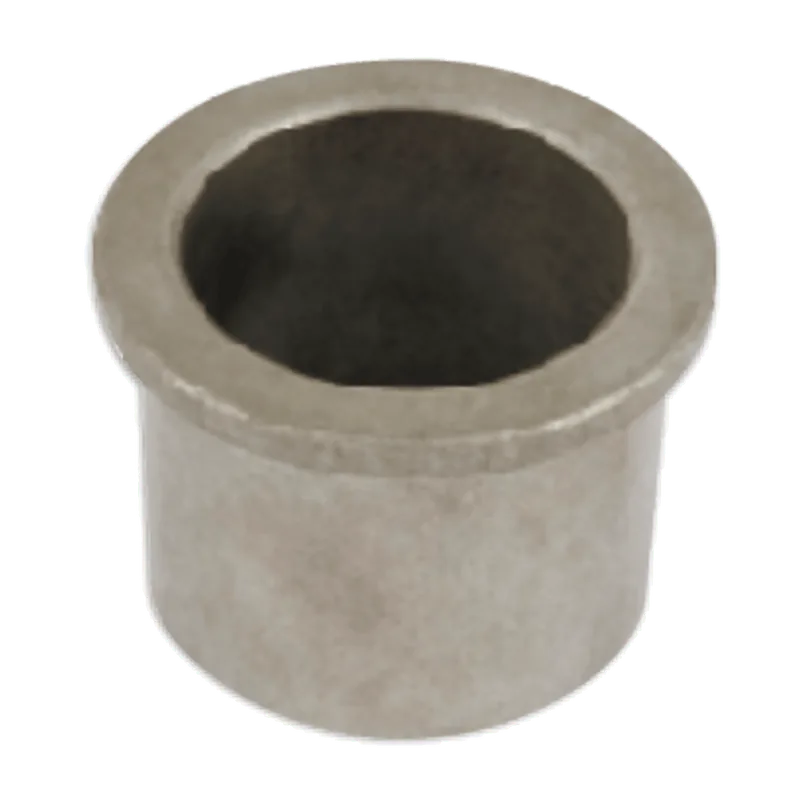
Flanged Iron Bushings FP20
FP20 flanged sintered iron self-lubricating bushings, oil-impregnated and maintenance-free. 52 variants, bore Ø3–60 mm, integral collar. ISO 2795 class.
- Material
- FP20 Iron
- Family
- Flanged Bushings
- References
- 52 available sizes
- Supply
- Standard sizes and project quantities
Choose your size
52 original dimensional references are available for this product group.
Selected reference: Ø Int. 3 - Ø Ext. 6 - Long. 4 - Ø Coll. 9 - Ép. 1,5
Request this size →The Flanged Iron Bushings FP20 are oil-impregnated, self-lubricating sintered bearings produced from FP20 sintered iron with an integral flange (collar) that combines a cylindrical journal-bearing bore with a shoulder for axial location and light thrust duty in a single pressed and sized component. Across this family, 52 variants cover bores from Ø 3 mm to Ø 60 mm, letting designers standardise on one bearing type for miniature mechanisms up to substantial industrial pivots while retaining the same maintenance-free operating principle throughout.
Every part is characterised by five dimensions: internal diameter (bore), external diameter (barrel OD), overall length, collar diameter and flange thickness. The smallest catalogue size measures Ø Int. 3 mm, Ø Ext. 6 mm, length 4 mm, collar Ø 9 mm and flange thickness 1.5 mm; the largest measures Ø Int. 60 mm, Ø Ext. 70 mm, length 60 mm, collar Ø 80 mm and flange thickness 5 mm. In both cases the flange overhangs the barrel radially — 1.5 mm per side on the small part and 5 mm per side on the large part — providing a positive seat against the housing face.
FP20 sintered iron offers a harder, more economical and more wear-resistant running surface than sintered bronze grades, making it a well-established choice for moderate-speed, moderate-load applications where oil-film replenishment from the porous matrix removes the need for external lubrication. The flanged geometry makes this range particularly suited to vertical shafts, pivots and any assembly where the bearing must both guide the shaft and resist an axial thrust component.
How it works
FP20 sintered iron is manufactured by compacting iron-based metal powder and sintering it below the melting point, producing a rigid structure that retains roughly 20–25% interconnected porosity by volume. This open pore network is vacuum-impregnated with lubricating oil, so each bushing arrives pre-charged and ready to run dry with no external oiling. When the shaft rotates, frictional heat and the localised pressure of the developing hydrodynamic film cause the oil held in the pores to expand and be drawn to the bearing surface by capillary action, forming a continuous lubricating film between shaft and bore. As the assembly cools and stops, capillary forces reabsorb most of the oil back into the matrix, so it is retained rather than lost — the mechanism that gives these bearings their maintenance-free, self-lubricating character over long service intervals.
Because the lubricant is stored throughout the wall thickness, the reservoir scales with the size of the part: the longer, thicker-walled large variants (for example the Ø 60 mm bore, 60 mm long size with a 5 mm wall) hold considerably more oil than the miniature Ø 3 mm size, supporting longer running between any eventual re-impregnation. The integral flange shares the same porous, oil-charged structure as the barrel, so the thrust face at the collar is lubricated on the same principle as the bore, easing the light axial contact typical of vertical or shoulder-loaded installations.
Technical characteristics
| Material | FP20 oil-impregnated sintered iron |
|---|---|
| Family | Flanged (collared) bushings |
| Variants available | 52 |
| Bore diameter (Ø Int.) range | 3 mm to 60 mm |
| Outside diameter (Ø Ext.) range | 6 mm to 70 mm |
| Overall length range | 4 mm to 60 mm |
| Collar diameter (Ø Coll.) range | 9 mm to 80 mm |
| Flange thickness (Ép.) range | 1.5 mm to 5 mm |
| Lubrication | Self-lubricating, oil-impregnated (maintenance-free) |
| Interconnected porosity | Typically 20–25% by volume (material class) |
Typical applications
- Vertical shaft supports and pivots where the flange carries a light axial thrust component
- Electric motor and gearmotor end-shields, fan and blower assemblies
- Automotive ancillaries: seat mechanisms, pedal boxes, window and wiper linkages
- Household and power-tool gearboxes and drive mechanisms
- Office equipment, printers and document-handling rollers
- Agricultural and garden machinery pivots and control linkages
- Pumps, actuators and general light-industrial machinery bearings
- Hinges, dampers and adjustment mechanisms needing a located, maintenance-free bush
Installation & fitting
Sintered flanged bushings are designed to be secured by an interference press-fit into a rigid, close-tolerance housing bore, with the flange seating flat against the housing face to provide axial location. Observe the following to preserve performance:
- Machine the housing bore to a clean, round tolerance (typically H7) so that the press-fit closes the porous structure evenly; the bore of the fitted bush contracts slightly, so final running clearance is achieved after installation rather than before.
- Press only on the flange face or via a piloted mandrel that supports the bore — never hammer directly on the barrel, as impact can distort the sintered wall (as thin as 1.5 mm on the small Ø 3 mm bore).
- Ensure the housing shoulder is square and flat so the flange, from 1.5 mm to 5 mm thick across the range, beds down fully and locates the assembly without cocking.
- Do not ream, hone or machine the bore after fitting — cutting would smear and seal the surface pores, cutting off oil release. Where a tighter running fit is required, use a non-cutting sizing pin (ball-sizing) that burnishes rather than removes material.
- Keep the shaft smoothly finished and free of sharp edges; a chamfered lead-in eases assembly and protects the bore surface. Wipe parts clean and handle with clean hands or gloves, since solvents and degreasers can leach the impregnated oil from the pores.
- If storage has been prolonged, parts may be re-impregnated by soaking in warm bearing oil before installation to top up the reservoir.
Selection guidance
Choose the flanged FP20 range when the bearing must both guide a shaft and provide axial location or absorb light thrust — the integral collar removes the need for a separate thrust washer or shoulder. Prefer FP20 sintered iron over sintered bronze grades (such as BP25) where cost efficiency, higher hardness and abrasion resistance are priorities and running speeds are moderate; bronze grades remain the better choice for higher-speed, higher-conformability duty or where the running mate is unhardened and prone to scoring. Select a straight (unflanged) cylindrical bush instead when the housing already provides axial location and no shoulder is needed. Within this family, match the bore to your shaft and pick the length that gives adequate projected bearing area for the radial load: the short miniature sizes (from 4 mm long) suit compact instrument mechanisms, while the longer sizes (up to 60 mm long) suit heavier, better-aligned industrial shafts. Treat load, speed and temperature limits as typical for the sintered-iron material class and validate them against your specific duty cycle.
Available references
52 original dimensional references are available for this product group.
Frequently asked questions
Do FP20 flanged bushings need greasing or oiling in service?
What is the purpose of the flange (collar) on these bushings?
How is FP20 sintered iron different from sintered bronze bushings?
Can I machine or ream the bore to size after pressing the bush in?
What bore sizes are available in this flanged FP20 range?
What load and temperature can these bushings handle?
Application-focused selection
Send dimensions, load, speed, temperature and environmental conditions for a technical review.
Request a quote ↗