
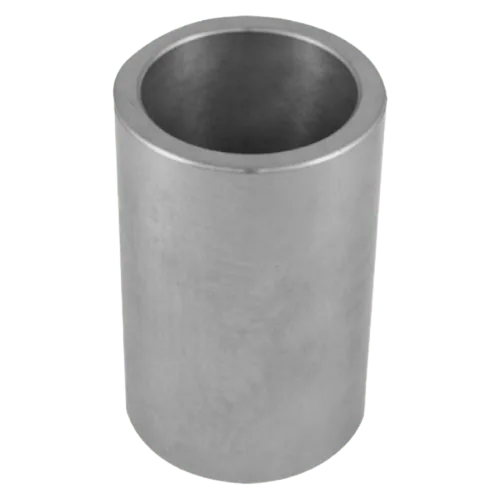
Hollow Bearing Blanks FP20
Oil-impregnated FP20 sintered iron hollow blanks for turning custom self-lubricating bushings. Five sizes, bores 38-85 mm, 120 mm long, maintenance-free.
- Material
- FP20 Iron
- Family
- Hollow Blanks
- References
- 5 available sizes
- Supply
- Standard sizes and project quantities
Choose your size
5 original dimensional references are available for this product group.
Selected reference: Ø Int. 38 - Ø Ext. 70 - Long. 120
Request this size →Hollow Bearing Blanks FP20 are thick-walled tubular billets of oil-impregnated sintered iron, supplied as semi-finished stock for machining into bespoke self-lubricating bushings, sleeves and thrust components. Instead of settling for a catalogue bore, the workshop turns, bores and parts each blank to the exact geometry an application demands, while retaining the interconnected porosity and impregnated oil reservoir that make the material maintenance-free in service.
The range spans five sizes. The two documented references — Ø int. 38 x Ø ext. 70 x 120 mm and Ø int. 85 x Ø ext. 105 x 120 mm — illustrate the format: a 120 mm working length that can be parted into several shorter bushes, over a radial wall of roughly 16 mm on the 38/70 blank and 10 mm on the 85/105 blank. That wall carries generous machining allowance on both bore and outside diameter, so finished parts can be cut to an interference fit without breaking through the porous body.
FP20 is the sintered iron grade of the Metafram-type self-lubricating family — a lower-cost, higher-hardness alternative to sintered bronze that suits heavier, lower-speed duty. Every blank is vacuum-impregnated with mineral oil before dispatch, so the porosity is already charged and ready to feed the sliding interface once the part is finished and fitted.
How it works
Sintered iron is pressed and sintered from iron powder so that roughly 20-25% of its volume remains as a network of interconnected pores. Under vacuum this pore network is flooded with lubricating oil, turning the bushing wall into an integral oil reservoir. In service, frictional heat and the slight pressure of the rotating shaft draw oil out of the pores by capillary action, building a hydrodynamic film between shaft and bore. When motion stops and the part cools, capillary forces pull the oil back into the porosity, so it is retained rather than lost. This closed cycle is what lets an FP20 bush run dry — without grease fittings, oil lines or periodic re-lubrication — for much of its working life.
Because the oil supply lives inside the wall, the mechanism only works if machining preserves the surface porosity. Smeared or glazed bore surfaces seal the pores shut and starve the interface, so blanks must be finished with sharp tooling and light cuts (detailed under Installation) to keep the capillary paths open on the finished running surface.
Technical characteristics
| Material | FP20 oil-impregnated sintered iron |
|---|---|
| Product form | Hollow blanks, fully machinable |
| Lubrication | Self-lubricating, maintenance-free (no external oiling) |
| Interconnected porosity | Approx. 20-25% by volume (typical for the material class) |
| Impregnation | Mineral oil, vacuum-impregnated and pre-charged |
| Bore / OD as supplied | Ø int. 38-85 mm / Ø ext. 70-105 mm across the range |
| Blank length | 120 mm, partable into multiple bushes |
| Radial wall stock | Approx. 16 mm (38/70) to 10 mm (85/105) with machining allowance |
| Variants available | 5 sizes |
| Typical service window | Approx. -20 to +100 C continuous, sliding speeds to ~2 m/s (material-class typical) |
Typical applications
- Custom-bore sleeve bearings turned to non-standard shaft sizes
- Heavier-duty, low-to-moderate-speed pivots and oscillating linkages
- Agricultural and construction machinery bushings
- Conveyor rollers, drums and idler bearings
- Pump, gearbox and reduction-drive spacer or idler bushes
- Automotive and off-highway suspension, pedal and steering pivots
- Thrust washers and collars parted from the blank
- Material-handling equipment, hinges and heavy hinged joints
- Bespoke flanged bushings machined from a single billet
- Replacement bushes for legacy equipment with obsolete sizes
Installation & fitting
These are semi-finished blanks: the running surface is created by the customer, so machining technique decides whether the finished bush self-lubricates. Preserve the surface porosity throughout.
- Cut dry. Do not flood with cutting fluid or soluble oil — coolant is drawn into the pores and displaces the impregnated lubricant. Machine dry, with sharp carbide tooling, high surface speed and light feed to shear rather than smear the surface.
- Avoid reaming the bore. Reaming and heavy burnishing glaze the pores shut. Bore or turn to size, then finish to fit with a sizing pin that opens rather than seals the porosity.
- Part off from length. The 120 mm billet parts cleanly into several shorter bushes or thrust washers; deburr edges lightly without rolling material over the bore mouth.
- Press-fit into the housing. Finished bushes are retained by interference in a rigid H7 housing bore, using an arbor and a lead-in chamfer — never hammered directly. No adhesive or grub screw is needed.
- Allow for bore close-in. Press-fitting contracts the bore slightly; machine the finished ID with an allowance so it closes onto the target running clearance, and verify clearance after assembly.
- Re-impregnate if heavily worked. After extensive machining, blanks can be re-soaked in bearing oil to top up the reservoir before assembly.
Selection guidance
Choose FP20 hollow blanks when no standard bushing matches the geometry — an unusual bore, a long or flanged sleeve, a thrust collar — and you want to machine it in-house from self-lubricating stock rather than from solid steel that would then need separate lubrication. Within the sintered range, specify FP20 sintered iron over BP25 sintered bronze where the duty is heavier and slower and cost matters: iron offers higher hardness and load capacity at the expense of corrosion resistance and high-speed capability. If the environment is wet or corrosive, or the speed is high, favour a bronze grade; if you need a ready-to-fit standard size rather than a billet, choose a finished bushing instead of a blank. The 120 mm length and thick wall make these blanks particularly economical when several bushes are parted from a single billet.
Available references
5 original dimensional references are available for this product group.
Frequently asked questions
What is FP20 and how is it self-lubricating?
Why choose a machinable blank instead of a finished bushing?
How do I machine the material without ruining its self-lubrication?
Do the finished bushings need periodic lubrication?
Should I specify FP20 iron or BP25 bronze?
How many bushes can I get from one 120 mm blank?
Application-focused selection
Send dimensions, load, speed, temperature and environmental conditions for a technical review.
Request a quote ↗