
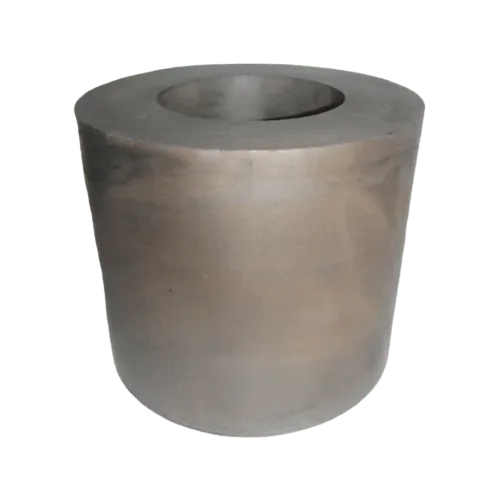
Hollow Bearing Blanks SO16
SO16 oil-impregnated sintered alloy hollow bearing blanks - machinable semi-finished tube stock from Ø38/Ø70/120 to Ø85/Ø105/120mm. Bore to your exact fit.
- Material
- SO16 Alloy
- Family
- Hollow Blanks
- References
- 5 available sizes
- Supply
- Standard sizes and project quantities
Choose your size
5 original dimensional references are available for this product group.
Selected reference: Ø Int. 38 - Ø Ext. 70 - Long. 120
Request this size →The Hollow Bearing Blanks SO16 are oil-impregnated, self-lubricating sintered alloy tube stock supplied as machinable semi-finished blanks. Rather than a finished bushing turned to a catalogue bore, each blank is a generously walled cylinder intended to be mounted, faced, bored and turned to your exact application geometry - letting you produce non-standard bearings, thick-wall thrust collars or custom flanged bushes from a single self-lubricating base material.
This family spans five variants, with sample geometries running from Ø int. 38 - Ø ext. 70 - long. 120 mm up to Ø int. 85 - Ø ext. 105 - long. 120 mm. The smaller sample carries a nominal wall of roughly 16 mm ((70-38)/2), and the larger a wall of about 10 mm ((105-85)/2), so both leave ample stock for finish-boring, external turning and parting into multiple shorter bearings from one 120 mm length.
SO16 is a sintered alloy matrix with a controlled network of interconnected porosity that is vacuum-impregnated with lubricating oil. The pore structure is retained through the wall, meaning that even after you remove machining stock the freshly exposed running surface remains oil-bearing and self-lubricating - the defining advantage of machining from an impregnated blank rather than press-fitting a rigid finished bush.
How it works
Like all oil-impregnated sintered bearings, SO16 relies on capillary action within a network of interconnected pores that typically occupies on the order of 20-25% of the material volume. This porosity is filled with lubricating oil under vacuum impregnation. In service, frictional heat and the local pressure field at the shaft-to-bore contact draw a microscopic oil film out of the pores and onto the running surface; when motion stops and the bearing cools, capillary forces reabsorb the oil back into the matrix. The result is a self-replenishing hydrodynamic film that supports maintenance-free, dry-running operation with no external greasing.
Because the porosity is distributed through the full wall thickness of the blank, this mechanism survives machining. When you bore the Ø38 or Ø85 sample down to a final fit, the newly cut surface exposes fresh pores that are already charged with oil, so the finished bearing is self-lubricating from first rotation - provided the machining is done without pore-sealing (see installation guidance).
Technical characteristics
| Material | SO16 oil-impregnated sintered alloy |
|---|---|
| Product form | Hollow bearing blank (machinable semi-finished stock) |
| Family | Hollow Blanks (machinable) |
| Variants available | 5 |
| Bore range (sample) | Ø int. 38 to Ø int. 85 mm |
| Outside diameter range (sample) | Ø ext. 70 to Ø ext. 105 mm |
| Length (sample) | 120 mm |
| Nominal wall thickness (sample) | ~16 mm (38/70) to ~10 mm (85/105) |
| Lubrication | Self-lubricating, oil impregnated - maintenance-free |
| Standard reference class | Sintered self-lubricating bearing material (ISO 2795 / DIN 1850 type) |
Typical applications
- Custom self-lubricating bushings machined to non-standard bore/OD combinations not covered by catalogue sizes
- Thick-wall bearings and thrust collars where the ~10-16 mm sample wall provides ample finishing stock
- Prototype and low-volume bearing production where a single blank replaces bespoke tooling
- Flanged and shouldered bushes turned in one piece from the 120 mm length
- Parting one 120 mm blank into several shorter bearings of matched bore
- Replacement bearings for legacy or obsolete machinery reverse-engineered to worn shaft dimensions
- Large-diameter guide and pivot bearings (up to the Ø85 bore sample) for slow-speed oscillating motion
- Maintenance-free bearings for enclosed drives, actuators and mechanisms where regreasing is impractical
Installation & fitting
These are semi-finished blanks and are supplied to be machined to final dimensions before use. To preserve the self-lubricating function, observe the standard precautions for oil-impregnated sintered material:
- Machine with sharp tooling, light cuts and high surface speed. Use finishing cuts on the bore to shear the pores open cleanly rather than smearing and sealing them.
- Do not use dull tools, heavy feeds, or abrasive/lapping compounds on the running surface - these burnish and close the surface porosity, destroying oil release.
- Machine dry or with a compatible cutting oil; avoid water-based or aggressive coolants that can flush impregnation oil from the pores.
- Support the thin-wall region of the larger Ø85/Ø105 blank when clamping so chuck pressure does not distort the finished bore.
- Press the finished bush into a rigid housing with the correct interference fit. Bore closure on press-fit is normal for sintered bearings, so size the pre-press bore to allow for it and check the final running clearance after installation.
- Chamfer bore edges to ease shaft entry and avoid scraping the running surface during assembly. Re-impregnate or oil-soak the finished part if it has been extensively machined or degreased before it goes into service.
Selection guidance
Choose the SO16 hollow blank when no catalogue finished bushing matches your required bore, OD and length combination, or when you need a wall thickness and feature set (flange, shoulder, groove) that only in-house machining can deliver. Compared with ordering a finished sintered bush, the blank trades a machining operation for complete dimensional freedom while keeping full through-wall self-lubrication. Within this family, work down from the closest oversize sample - the Ø38/Ø70 blank suits smaller bores needing a heavy wall, while the Ø85/Ø105 blank covers large-diameter bearings; both share the 120 mm length, so pick by finished OD and bore first, then part to length. If your requirement is a standard-size, ready-to-fit bearing with no machining, select a finished bushing SKU (BP25 sintered bronze or FP20 sintered iron) instead; reserve these blanks for custom, prototype and reverse-engineered work.
Available references
5 original dimensional references are available for this product group.
Frequently asked questions
Are these blanks already impregnated with oil, or do I oil them after machining?
How much material can I remove from the bore and OD?
Why machine from a blank instead of buying a finished bushing?
Will machining ruin the self-lubricating property?
What load, speed and temperature can the finished bearing handle?
Can I cut several shorter bearings from one 120 mm blank?
Application-focused selection
Send dimensions, load, speed, temperature and environmental conditions for a technical review.
Request a quote ↗