
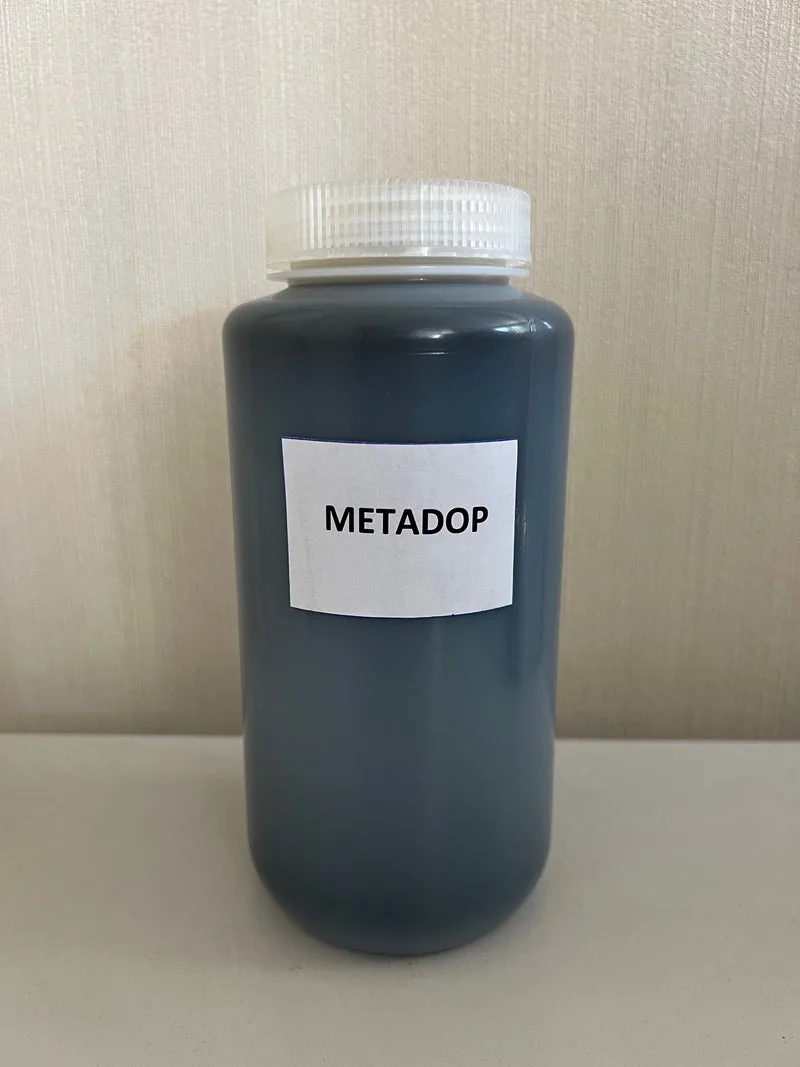
Impregnation Oil for SO16 — METADOP
METADOP self-lubricating impregnation oil for SO16 sintered blanks. Charges the ~20-25% pore network for maintenance-free, dry-running bearings. 1-litre pack.
- Material
- METADOP
- Family
- Industrial Oils
- References
- 1 available sizes
- Supply
- Standard sizes and project quantities
Choose your size
1 original dimensional references are available for this product group.
Selected reference: Default Title
Request this size →METADOP is the impregnation oil engineered to bring SO16 self-lubricating sintered blanks to life. SO16 is supplied as solid, machinable pucks and bars of Metafram-type sintered alloy whose defining feature is an interconnected pore network occupying, as is typical for this class, roughly 20-25% of the material volume. That porosity is only useful once it is charged with the correct lubricant, and METADOP is the fluid matched to the SO16 matrix for exactly that purpose.
Supplied in a practical 1-litre pack, this oil is intended for two closely related jobs: charging the pores of freshly machined SO16 blanks so the finished bush runs dry and maintenance-free, and re-impregnating SO16 bearings during overhaul when their original oil charge has been depleted by long service. Because turning, boring and reaming can smear surface porosity and flush oil out of the cut zone, re-impregnation with the matched oil is what restores full self-lubricating behaviour to a machined SO16 component.
One litre is a workshop-scale quantity suited to prototype runs, small production batches and maintenance-repair-overhaul work. Rather than being defined by a certified load or PV figure of its own, METADOP is specified by its role in the SO16 system: it is the reservoir that a sintered self-lubricating bearing draws on across its entire service life.
How it works
A sintered self-lubricating bearing is, in effect, a rigid metal sponge. During manufacture the SO16 powder is compacted and sintered to leave the interconnected porosity characteristic of this material class — typically around 20-25% by volume — and METADOP is drawn into that capillary network. This works most completely under vacuum, which evacuates the trapped air so oil can be pulled deep into the pores; once charged, the pore structure behaves as a distributed oil reservoir sealed inside the bearing wall.
In operation, friction at the shaft raises the local temperature and the trapped oil expands faster than the surrounding metal. That differential thermal expansion, together with the hydrodynamic wedge formed as the shaft rotates, pushes a thin film of METADOP out to the running surface, separating shaft and bore with no external lubrication. When the bearing slows and cools, capillary action draws the oil back into the pore network, ready for the next cycle. The viscosity and anti-oxidant / anti-corrosion additive package of METADOP are chosen so this charge, release and reabsorb cycle repeats dependably over a long maintenance-free life in ISO 2795 / DIN 1850-style sintered bushes.
Technical characteristics
| Product type | Sintered-bearing impregnation and re-impregnation oil |
|---|---|
| Formulated for | SO16 self-lubricating sintered blanks (Metafram-type alloy) |
| Base fluid | Refined lubricating oil with anti-oxidant / anti-corrosion additives (typical for the class) |
| Viscosity band | Medium viscosity matched to sintered-bush service; broadly ISO VG 68-100 territory for this bearing class (indicative, not a certified SKU spec) |
| Target pore fill | Interconnected porosity of ~20-25% by volume in the sintered matrix |
| Application methods | Vacuum impregnation, hot-oil immersion, or in-service soak top-up |
| Typical service temperature | Roughly -10 to +100 C continuous for standard mineral impregnation oils (typical for the material class, not certified for this pack) |
| Function | Maintenance-free, dry-running boundary and hydrodynamic film generation |
| Pack size | 1 litre (single variant) |
| Compatibility | Matched to SO16; not a substitute for bronze- or iron-matrix impregnation oils |
Typical applications
- Charging the pores of freshly machined SO16 self-lubricating blanks
- Re-impregnating SO16 sintered bushes during overhaul and refurbishment
- Prototype and small-batch bearing manufacture from solid SO16 blanks
- Maintenance top-up of oil-impregnated bushings that have run low
- Electric-motor end bearings and fan or blower bushings
- Automotive auxiliary motors, actuators and light mechanisms
- Domestic-appliance and power-tool bushings
- Office equipment, pumps and light-duty gearmotors
- Bench-top vacuum-impregnation and hot-immersion setups in workshops
- General MRO of Metafram-type sintered self-lubricating bearings
Installation & fitting
METADOP is applied to the porous material rather than press-fitted itself; the guidance below covers charging the oil and handling the fluid. The finished SO16 bush is then press-fitted into its housing by normal sintered-bearing practice, after which the impregnated oil does its work with no further lubrication.
- Vacuum impregnation (preferred): load clean, dry SO16 blanks into a basket, evacuate the chamber to draw air out of the pores, then flood with METADOP and release the vacuum so oil is forced into the evacuated capillaries. Gently warming the oil lowers its viscosity and speeds uptake.
- Hot-oil immersion: where vacuum equipment is unavailable, submerge the parts in warm METADOP and hold until bubbling from escaping air stops — the sign that the pores have filled.
- In-service re-oiling: a bush that has run dry can often be revived by soaking it in warm oil until it stops releasing bubbles, restoring much of the original charge.
- Finishing: wipe away surface excess so only the pore-held reservoir and a light running film remain; do not solvent-flush an impregnated part, as that strips the charge.
- Handling and storage: use clean, dedicated containers and keep the oil free of particulates and water; reseal after use and store cool, dry and away from strong oxidisers. Observe standard lubricant-handling PPE and disposal practice.
- Press-fit note: when fitting the finished SO16 bush, press on a hardened arbor and size to the housing bore rather than the ID — never ream an oil-impregnated bush, as reaming smears and seals the surface porosity.
Selection guidance
Choose METADOP when you are impregnating or re-impregnating SO16 self-lubricating blanks specifically: its formulation is matched to that alloy matrix and to the machine-then-charge workflow SO16 blanks are built around. If your bearing is pressed or sintered from a bronze grade such as BP25 or an iron grade such as FP20, select the impregnation oil matched to that material instead, since the pore structure and duty of each matrix differ. The 1-litre pack is sized for workshop impregnation, prototype work and MRO top-ups; for continuous production charging, scale the quantity to your batch throughput. Where a certified viscosity grade, service-temperature window or oil-analysis certificate is required for a regulated application, request the supplier data sheet rather than relying on the typical class figures quoted here.
Available references
1 original dimensional references are available for this product group.
Frequently asked questions
What is METADOP impregnation oil used for?
Why re-impregnate a blank after machining it?
Do I need a vacuum rig to use it?
How much of the SO16 material is actually oil?
Does the 1-litre pack come with load or temperature ratings?
Can I use METADOP on bronze or iron sintered bearings?
Application-focused selection
Send dimensions, load, speed, temperature and environmental conditions for a technical review.
Request a quote ↗