
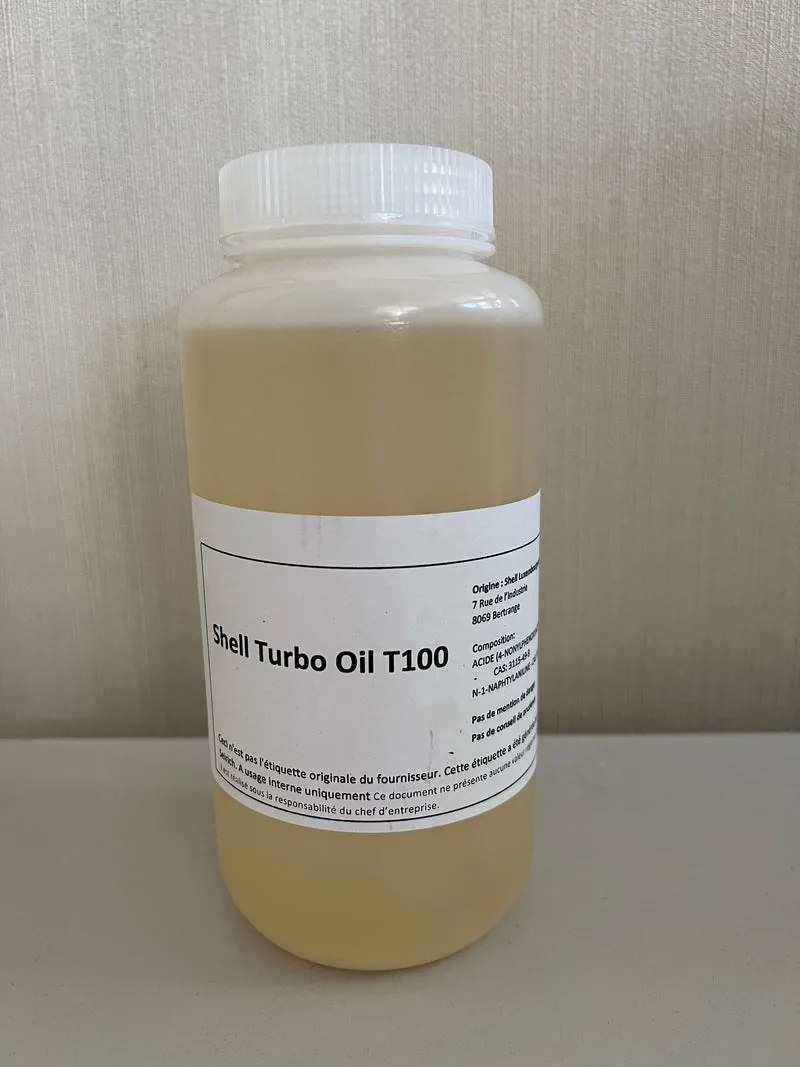
Impregnation Oil for BP25 & FP20 — TURBO T100
TURBO T100 impregnation oil, 1 litre. Re-charges the interconnected porosity of BP25 sintered bronze and FP20 sintered iron self-lubricating bushings.
- Material
- TURBO T100
- Family
- Industrial Oils
- References
- 1 available sizes
- Supply
- Standard sizes and project quantities
Choose your size
1 original dimensional references are available for this product group.
Selected reference: Default Title
Request this size →TURBO T100 is a low-viscosity mineral impregnation oil supplied in a 1 litre pack, formulated to fill and re-charge the interconnected pore network of oil-impregnated sintered self-lubricating bushings. It is intended specifically for the two most common sintered matrices in the Bushingo range: BP25 sintered bronze (ISO 2795 / DIN 1850 grade) and FP20 sintered iron. Rather than being an accessory, this oil is the working reservoir of the bearing system itself: it lives inside the porous wall and is drawn to the sliding surface by capillary action during operation.
Sintered self-lubricating bushings ship pre-impregnated from the factory, but the oil charge is a finite consumable. Over a long service life, through evaporation, migration, wash-off, and the small quantities carried away on the mating shaft, the fill fraction of the porosity gradually falls. TURBO T100 exists to restore that charge — either during a controlled vacuum re-impregnation of a batch of bushes, or as a top-up applied to bearings already in service. A single 1 litre container holds enough fluid to re-charge a large quantity of small and medium bushings, since each bearing only stores a few grams of oil within its pore volume.
Because it is matched to the porosity, wettability, and typical operating regime of BP25 and FP20, TURBO T100 preserves the maintenance-free, dry-running behaviour these materials are chosen for. Using a correctly matched impregnation oil is what keeps the bearing self-sufficient across its life; using an incompatible or heavier fluid can starve the sliding interface exactly when it is needed most.
How it works
An oil-impregnated sintered bushing works because roughly 20–25% of its wall volume is open, interconnected porosity that behaves as a distributed oil reservoir. TURBO T100 is the fluid that fills this network. At rest, surface tension holds the oil inside the pores. When the shaft turns, two effects release it: frictional heat causes the trapped oil to expand more than the surrounding metal skeleton, and the local pressure and shear at the contact draw a microscopic film to the running surface. This builds a hydrodynamic-to-boundary lubricating film without any external oiler, grease nipple, or maintenance cycle — the defining feature of a self-lubricating bearing.
When motion stops and the bearing cools, capillary action reverses the flow and the oil is re-absorbed back into the porosity, ready for the next start. TURBO T100's low viscosity is deliberately chosen so it can move freely through the fine, tortuous pore channels of BP25 bronze and FP20 iron — both to re-fill them during impregnation and to feed the interface reliably at low speeds and on start-up, where a heavier oil would be too sluggish to reach the contact in time.
Technical characteristics
| Product type | Impregnation / replenishment oil (mineral base) |
|---|---|
| Designation | TURBO T100 |
| Pack size | 1 Litre |
| Compatible materials | BP25 sintered bronze, FP20 sintered iron |
| Function | Re-charges interconnected pore reservoir (~20–25% porosity) |
| Viscosity class | Low viscosity — free capillary flow through fine pores |
| Release mechanism | Thermal expansion + capillary draw to sliding surface |
| Application methods | Vacuum re-impregnation or in-service top-up |
| Additive character | Typically anti-oxidant / anti-wear for long reservoir life |
| Variants | 1 (single pack size) |
Typical applications
- Vacuum re-impregnation of a batch of BP25 bronze or FP20 iron bushings during overhaul
- In-service top-up of self-lubricating bushings showing early signs of oil depletion (increased running noise or drag)
- Restoring the oil charge of bearing blanks that have been in long-term storage before machining and fitting
- Field maintenance of maintenance-free bushings in fractional-horsepower motors and gearmotors
- Re-charging bushings in household appliances, fans, and pumps where relubrication access is limited
- Replenishing sintered bushes in office equipment, actuators, and light automation mechanisms
- Servicing low-speed, oscillating, or intermittent-duty pivots and linkages running on sintered bearings
- Workshop preparation of press-fit sintered bushings prior to installation into a new housing
Installation & fitting
TURBO T100 is applied to the bushing, not to a mating part, and the goal is always to fill the porosity — not merely to wet the surface. Choose the method to suit the situation.
- Vacuum re-impregnation (most thorough): submerge the cleaned, dry bushings in the oil and draw a vacuum to evacuate air from the pores, then release to atmosphere so the oil is forced into the evacuated network. Heating the oil moderately lowers its viscosity and speeds penetration.
- Hot-soak method: immerse the bushings in TURBO T100 held warm for an extended period; rising temperature expels pore air and draws oil in as the parts cool. Less complete than vacuum but effective for top-ups.
- In-service top-up: apply the oil to the exposed bearing surface and any accessible end faces and allow it to wick in; repeat until the surface stays visibly oil-fed.
Handling: keep the oil, containers, and bushings clean and free of grit — a sintered bearing cannot be flushed, so contamination trapped in the pores is permanent. Do not thicken or dilute the oil with greases or solvents, and do not substitute a heavier oil, as this defeats the capillary feed. Wipe external surfaces after impregnation, store the 1 litre container sealed and cool, and observe the safety-data-sheet guidance for a mineral oil.
Selection guidance
Choose TURBO T100 when your self-lubricating bearings are BP25 sintered bronze or FP20 sintered iron and you need a low-viscosity fluid to re-establish their internal oil charge — either as a batch re-impregnation during overhaul or as an in-service top-up. It is the correct default for general-purpose, ambient-temperature maintenance of these two materials. If your application involves a markedly different regime — for example very high or very low temperatures, food-contact requirements, or bushings made from a different matrix such as the SO16 alloy or Metagliss composite range — request the impregnation oil specified for that material and duty instead, rather than forcing a mismatch. The 1 litre pack suits workshop and field maintenance; for high-volume production re-impregnation, ask about bulk supply.
Available references
1 original dimensional references are available for this product group.
Frequently asked questions
What is TURBO T100 used for?
Which bushings is it compatible with?
How much can one litre re-impregnate?
Do sintered bushings really need re-oiling?
Can I use a heavier oil or grease instead?
What is the best way to re-impregnate a batch of bushes?
Application-focused selection
Send dimensions, load, speed, temperature and environmental conditions for a technical review.
Request a quote ↗