
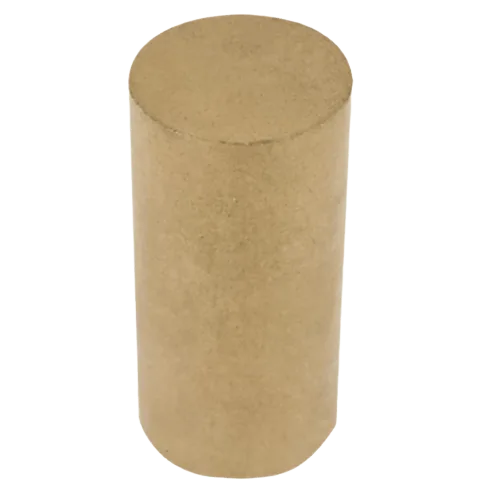
Solid Bearing Blanks BP25
Machinable BP25 oil-impregnated sintered bronze blanks, 7 sizes from Ø20x40 to Ø145x120 mm. Turn custom self-lubricating bearings, thrust washers and bushes.
- Material
- BP25 Bronze
- Family
- Solid Blanks
- References
- 7 available sizes
- Supply
- Standard sizes and project quantities
Choose your size
7 original dimensional references are available for this product group.
Selected reference: Ø 20 - Long. 40
Request this size →Solid Bearing Blanks BP25 are fully sintered, oil-impregnated bronze cylinders supplied without a finished bore, giving your machine shop a self-lubricating stock material to turn, bore and profile into bearings that no catalogue bush covers. Each blank is pressed and sintered from BP25 tin-bronze powder (a Metafram-type CuSn10 composition) and vacuum-impregnated so the lubricant reservoir is already locked inside the structure before a tool ever touches it.
The range spans seven sizes, from a compact Ø 20 mm x 40 mm long slug up to a substantial Ø 145 mm x 120 mm long block, so you can machine anything from a small pivot sleeve to a large flanged sleeve or thrust washer from a single, homogeneous piece. Because the interconnected porosity - and therefore the oil - is distributed uniformly through the whole cross-section, the self-lubricating behaviour is preserved on every surface you expose during machining, not merely on an as-pressed skin.
Choose solid blanks when your bore diameter, wall thickness, flange geometry or overall length falls outside the standard sintered bush programme, or when you need a one-off or short-run custom bearing that still delivers the maintenance-free running of oil-impregnated bronze.
How it works
BP25 sintered bronze contains roughly 20-25% interconnected porosity that behaves like a sponge holding lubricating oil throughout the body of the material. At rest, capillary action retains the oil within the pore network. When a shaft turns against a machined surface, frictional heat and the local pressure of the moving journal cause the oil to expand and migrate out to the sliding interface, where it forms a thin hydrodynamic film that separates shaft and bearing.
As the assembly cools or the motion stops, capillary force draws the oil back into the pores, so the reservoir is continually recirculated rather than consumed. This is why an oil-impregnated bronze bearing runs maintenance-free and needs no external greasing for much of its service life - provided the machined running surface keeps its open porosity and is not smeared closed by dull tooling. The performance you obtain therefore depends directly on how the blank is finished, not only on the material itself.
Technical characteristics
| Material | BP25 sintered bronze (Metafram-type CuSn10, ~90% copper / 10% tin) |
|---|---|
| Structure | Interconnected porosity ~20-25% by volume, vacuum oil-impregnated |
| Oil content | Typically ~18-20% by volume mineral oil (approx. ISO VG 68-100 class) |
| Form | Solid machinable cylinder blank - no finished bore (customer-machined) |
| Size range | Ø 20 x 40 mm long up to Ø 145 x 120 mm long (7 variants) |
| Typical density | ~6.4-6.8 g/cm3 (oil-impregnated sintered bronze class) |
| Typical PV limit | Up to ~1.8 MPa·m/s continuous (material-class typical, not a certified SKU rating) |
| Typical surface speed | Up to ~6 m/s for the oil-impregnated bronze class |
| Typical operating temperature | ~ -20 to +100 °C, oil-limited (material-class typical) |
| Lubrication / standards | Maintenance-free, self-lubricating; conforms to ISO 2795 / DIN 1850 sintered bearing material |
Typical applications
- Custom-bore sleeve bearings turned to non-standard inside and outside diameters
- Flanged and shouldered bushes machined from solid where no stock size fits
- Thrust washers and axial bearing faces parted off from the larger blanks
- Oversized bushes beyond the catalogue range (up to the Ø 145 mm blank)
- Special or profiled bearings - stepped bores, grooved surfaces, spherical seats
- Pump, gearbox and actuator bearings requiring maintenance-free running
- Machine-tool slide and pivot components in humid or dusty environments
- Agricultural, textile and conveyor machinery pivots and rollers
- Short-run and prototype bearings where tooling a bored bush is not justified
- Replacement bearings reverse-engineered to legacy or obsolete dimensions
Installation & fitting
These are semi-finished blanks: the running surface is created by your own machining, so tool condition governs the finished bearing's performance. Handle them as oil-charged parts and protect the impregnation throughout the process.
- Use sharp, polished carbide tooling with positive rake, light cuts and moderate feed; blunt tools smear and close the surface pores, destroying the self-lubricating action.
- Machine dry or rely on the impregnated oil to lubricate the cut - avoid flooding with water-based coolant, which can flush lubricant from the pores. If coolant is unavoidable, or after heavy stock removal, re-impregnate the part by soaking it in warm oil.
- Leave a finishing allowance and bring the final bore to size with a fine finishing cut or by roller-sizing/burnishing after press-fit to reach the required tolerance and surface finish.
- Press the finished bush into a rigid H7 housing with an appropriate interference; the bore closes slightly on fitting, so size the bore after mounting wherever running clearance is critical.
- Chamfer the lead-ins, run against a ground shaft, and avoid steam-cleaning, aggressive degreasing or high-temperature baking of the finished part, all of which drive off the impregnation oil.
Selection guidance
Reach for Solid Bearing Blanks BP25 when a standard bored sintered bush cannot give you the bore, outside diameter, length or flange you need, or when the tolerances and profile are special enough to justify machining from solid. If your dimension already matches a stock cylindrical or flanged bush, a ready-bored part is faster and more economical. Where high loads, edge loading or oscillating dry conditions dominate, consider the sintered iron FP20 grade for greater strength, or a Metagliss composite plate for flat sliding surfaces. Choose BP25 bronze blanks when you want the balance of good conformability, corrosion resistance and quiet, maintenance-free running that tin-bronze provides, together with the freedom to cut your own geometry from a single homogeneous piece.
Available references
7 original dimensional references are available for this product group.
Frequently asked questions
Do I need to add oil to a bearing machined from these blanks?
Why choose solid blanks instead of a ready-bored bush?
Can I use cutting fluid when machining BP25?
What load and speed can these bearings take?
What tolerances should I machine to?
Are these blanks corrosion resistant?
Application-focused selection
Send dimensions, load, speed, temperature and environmental conditions for a technical review.
Request a quote ↗