
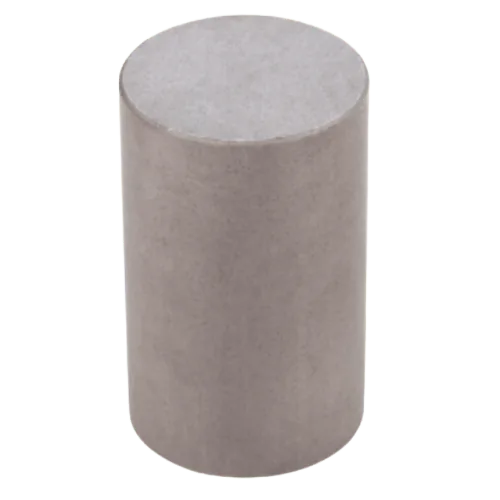
Solid Bearing Blanks FP20
FP20 sintered iron self-lubricating bearing blanks, oil-impregnated and fully machinable. 7 sizes from Ø20×40 to Ø145×120 mm for custom bore geometries.
- Material
- FP20 Iron
- Family
- Solid Blanks
- References
- 7 available sizes
- Supply
- Standard sizes and project quantities
Choose your size
7 original dimensional references are available for this product group.
Selected reference: Ø 20 - Long. 40
Request this size →Solid Bearing Blanks FP20 are oil-impregnated, self-lubricating cylinders of sintered iron supplied as semi-finished stock for in-house machining. Unlike finished bushes with fixed bore and outside diameter, these solid blanks give the designer a homogeneous porous body to turn, bore and part off to a custom geometry — the ideal route when a required bearing size falls outside a standard catalogue range, when an integral flange or shoulder is needed, or when a non-standard wall thickness is specified.
The range spans seven variants covering a broad dimensional envelope, from a compact Ø 20 mm blank 40 mm long up to a substantial Ø 145 mm blank 120 mm long. The smaller sizes suit slender pivots, linkage bushes and small plain bearings; the larger diameters provide enough stock for heavy sleeve bearings, thrust washers cut from the face, or multiple short bushes parted from a single length. Because the material is fully sintered and impregnated throughout its section, every surface exposed by machining is itself an oil-bearing surface.
FP20 sintered iron is the ferrous member of the self-lubricating family, chosen where higher hardness, greater bulk strength and lower material cost are preferred over the softer running characteristics of sintered bronze. It runs against steel shafts as a maintenance-free dry bearing, releasing its impregnated oil under running conditions and reabsorbing it at rest.
How it works
Sintered iron is produced by compacting iron powder in a die and sintering it below the melting point, leaving a rigid metal skeleton threaded with roughly 20-25% interconnected porosity. That open pore network is vacuum-impregnated with lubricating oil, which is held in the body by capillary action and typically fills the majority of the available pore volume. In service the blank machined into a bearing works as a self-contained lubrication system: as the shaft rotates, frictional heat and the hydrodynamic pressure of the moving journal draw oil out of the pores and into the running clearance, forming a supporting film. When motion stops and the bearing cools, capillary forces and thermal contraction reabsorb the oil back into the porous structure, so it is retained rather than lost.
This cycle repeats without any external lubrication, which is why bearings cut from FP20 blanks run maintenance-free and dry to the touch. Critically, the porosity and its oil charge are distributed through the whole solid section, so when the customer bores the blank to the final inside diameter or turns the outside diameter, the freshly exposed working surface is just as oil-rich as the original skin. The self-lubricating function is a bulk property of the material, not a surface coating that machining would remove.
Technical characteristics
| Material | FP20 sintered iron, oil-impregnated |
|---|---|
| Product form | Solid cylindrical blank (machinable semi-finished stock) |
| Family | Solid Blanks (machinable) |
| Variants available | 7 sizes |
| Smallest blank | Ø 20 mm × 40 mm long |
| Largest blank | Ø 145 mm × 120 mm long |
| Porosity | Typically ~20-25% interconnected, oil-filled |
| Lubrication | Self-lubricating, maintenance-free dry running |
| Structure | Ferrous — harder and stronger in bulk than sintered bronze |
| Standards reference | Sintered self-lubricating bearing material per ISO 2795 / DIN 1850 principles |
Typical applications
- Custom sleeve bearings machined to non-standard bore and OD combinations
- Integral-flange and shouldered bushes turned from a single solid piece
- Thrust washers and face-loaded bearing rings parted from the blank
- Short bushes cut in series from one length to reduce per-part cost
- Pivot and linkage bearings in agricultural and construction machinery
- Automotive suspension, pedal-box and door-hinge plain bearings
- General industrial gearboxes, pumps and conveyor rollers running on steel shafts
- Prototype and low-volume bearings where tooling a dedicated size is uneconomic
Installation & fitting
These blanks are supplied oversized for machining and must be finished to the target running clearance in-house. Observe the following when working and fitting them:
- Machine dry or with minimal cutting fluid. Use sharp tooling with light finishing cuts. Avoid flooding with coolant, which can wash oil from the surface pores; a light pass keeps the bore open and oil-rich.
- Do not smear the porosity. Blunt tools, excessive feed or aggressive burnishing can close the surface pores and blind the oil paths. Finish-bore rather than ream hard, and deburr gently.
- Allow for press-fit closure. When the finished bush is pressed into a rigid housing the bore contracts, so bore and check the inside diameter after fitting, or size the pre-fit bore to give the correct running clearance once installed. Provide a lead-in chamfer on the housing.
- Support the shaft correctly. Run against a smooth, hardened steel journal for best film formation and low wear.
- Re-oiling (optional). Machined blanks may be re-impregnated by soaking in warm bearing oil before assembly to top up any oil displaced during cutting.
Selection guidance
Choose Solid Bearing Blanks FP20 when no standard finished bush matches your requirement and you intend to machine the bearing yourself — for a non-catalogue bore/OD pair, an integral flange, an unusual length, or several short bushes cut from one length. Within the self-lubricating family, select the FP20 iron grade over sintered bronze (BP25) when you want greater bulk strength, higher hardness and lower material cost, and can accept a slightly harder-running ferrous bearing against a steel shaft; prefer bronze blanks where softer, quieter running, better corrosion resistance or higher surface conformability matter more. Pick the smallest blank diameter and length that leave adequate machining allowance around your finished dimensions: the Ø 20 × 40 mm size for compact pivots and small bushes, stepping up through the range to the Ø 145 × 120 mm size for large sleeve bearings, thrust rings or batch-parted production. If your target size already exists as a finished FP20 bush, that ready-machined part will usually be the more economical choice than machining from solid.
Available references
7 original dimensional references are available for this product group.
Frequently asked questions
What is FP20 and how does it differ from sintered bronze?
Why buy a solid blank instead of a finished bush?
Does machining the blank remove the self-lubricating property?
What sizes are available?
Do bearings made from these blanks need lubrication in service?
How should I machine the blanks?
Application-focused selection
Send dimensions, load, speed, temperature and environmental conditions for a technical review.
Request a quote ↗