
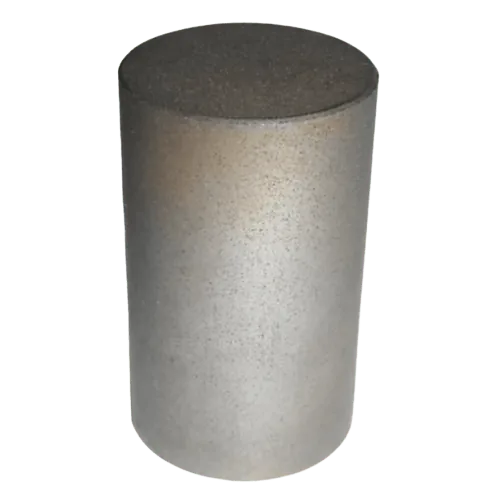
Solid Bearing Blanks SO16
SO16 solid sintered self-lubricating bearing blanks, oil-impregnated and ready to machine. 7 sizes from Ø20×40 to Ø145×120mm. Turn your own bushes to spec.
- Material
- SO16 Alloy
- Family
- Solid Blanks
- References
- 7 available sizes
- Supply
- Standard sizes and project quantities
Choose your size
7 original dimensional references are available for this product group.
Selected reference: Ø 20 - Long. 40
Request this size →The Solid Bearing Blanks SO16 are oil-impregnated sintered self-lubricating cylinders supplied as solid, machinable stock rather than finished bushes. Where a standard sintered bush arrives pressed to a fixed bore and length, these blanks give your workshop the freedom to turn, bore and part the exact bearing geometry your application demands from a homogeneous SO16 sintered alloy body that is already impregnated with lubricating oil throughout its interconnected pore network.
This range spans 7 variants, from a compact Ø 20 mm × 40 mm long blank suited to small shaft diameters and short bearing spans, up to a substantial Ø 145 mm × 120 mm long billet from which large-bore sleeves, thrust collars or multiple shorter bushes can be produced. Because the porosity and impregnation are integral to the sintered structure and not a surface treatment, the self-lubricating character is retained after machining: newly cut bore and face surfaces expose the same open, oil-filled porosity as the original skin.
SO16 solid blanks are the practical answer whenever a required bush size falls outside a standard catalogue, when a special flange, groove or profile must be integrated into the bearing, or when short-run and prototype quantities make dedicated tooling uneconomic. One blank family covers a wide dimensional envelope, letting a maintenance shop or OEM machine bespoke self-lubricating bearings on demand.
How it works
SO16 is a porous sintered alloy produced by compacting metal powder and sintering it below the melting point, which fuses the particles while deliberately leaving a network of interconnected voids, typically on the order of 20-25% of the volume for self-lubricating bearing grades. This open porosity is vacuum-impregnated with a low-viscosity mineral lubricating oil that is held throughout the body by capillary action. In service the running shaft and the frictional heat it generates warm the bearing; the oil in the pores expands slightly and is drawn to the sliding interface, forming a hydrodynamic film that separates shaft and bore. When motion stops and the bearing cools, capillary forces reabsorb the oil back into the pores, so the lubricant is stored, released and recovered internally.
This closed internal cycle is what makes the material maintenance-free and dry-running: no external greasing, no oil holes and no drip feed are required over the normal service life. Critically for a machinable blank, the self-lubricating mechanism lives in the bulk material, not in a coating. When you bore or face an SO16 blank the freshly exposed surfaces present the same oil-charged porosity as the outer surface, so a bush turned from this stock lubricates itself exactly as a factory-pressed sintered bush would, provided cutting practice keeps the pores open (see installation guidance).
Technical characteristics
| Material | SO16 sintered self-lubricating alloy |
|---|---|
| Product form | Solid machinable blank (billet/rod) |
| Family | Solid Blanks (machinable) |
| Lubrication | Oil-impregnated, self-lubricating, maintenance-free |
| Interconnected porosity | Typically ~20-25% by volume (material class) |
| Impregnant | Low-viscosity mineral lubricating oil (capillary-held) |
| Variants available | 7 sizes |
| Smallest blank | Ø 20 mm × 40 mm long |
| Largest blank | Ø 145 mm × 120 mm long |
| Standards reference | Sintered bearing practice per ISO 2795 / DIN 1850 material class |
Typical applications
- Machining custom-bore self-lubricating bushes when the required size is not a standard catalogue item
- Producing special bushes with integrated flanges, oil grooves, chamfers or shoulders in a single part
- Prototype and short-run bearing development where dedicated bush tooling is uneconomic
- Large-diameter sleeve bearings turned from the Ø 145 mm blank for heavy pivots and slow-speed journals
- Thrust washers and bearing collars faced from blank stock for axial location duties
- Replacement bushes for legacy or obsolete machinery where original parts are unavailable
- Multiple short bushes parted from a single longer blank for batch efficiency
- Maintenance-department stock held as raw material to service a range of shaft diameters from one item
Installation & fitting
Treat SO16 as a self-lubricating sintered material, not a solid bronze or steel bar. The goal of every machining operation is to cut the bore and faces cleanly while keeping the surface pores open, because those pores are the oil reservoir that makes the finished bush self-lubricating.
- Machine dry. Do not flood with cutting fluid or coolant. Coolant is drawn into the porosity by capillary action, displaces the impregnated lubricant and can leave the running surface starved. Dry cutting preserves the internal oil charge.
- Use sharp, keen tooling. Sharp, positive-rake, honed carbide or well-dressed HSS tools shear the material cleanly. Blunt or negative tooling smears and burnishes the surface, closing (glazing over) the pores and sealing off oil release.
- Take light finishing cuts at moderate speed. Fine feeds and light depths of cut on the final passes give a smooth bore without smearing. Avoid heavy rubbing.
- Do not ream or size by burnishing. Roller-burnishing or aggressive reaming can close the surface porosity. If a very fine finish is needed, use a light, sharp finish bore rather than a densifying operation.
- Deburr gently and lead in the bore. Provide a small entry chamfer to ease shaft insertion and avoid dragging swarf into the bore.
Press-fitting the finished bush. Sintered bearings are normally retained by an interference fit into a rigid housing. Because the material is porous and less ductile than wrought bronze, press with a piloted, flat-faced mandrel that supports the bore, apply steady axial force (arbor press rather than hammer blows), and keep the bush square to the bore to avoid chipping the edges. Remember that the housing interference closes the bore slightly: allow for this bore close-in when you machine, and check the running clearance after fitting. Where possible size the bore after pressing, or machine to allowance so the final running fit lands correctly.
Re-impregnation before service (optional). After extensive machining or long shelf storage, the finished part can be resoaked in bearing oil to top up the pore charge before installation.
Selection guidance
Choose SO16 solid blanks when you need to make a self-lubricating bearing rather than fit a standard one. They are the right choice for non-standard bores, integrated flanges or grooves, obsolete-part replacement, and prototype or short-run work. If your size and geometry match a stock item, a ready-pressed finished bush is faster and cheaper because it needs no machining. Within this family, pick the smallest blank that comfortably encloses your finished part: the Ø 20 × 40 mm blank suits small shaft bushes, while the Ø 145 × 120 mm blank is intended for large-bore sleeves, thick collars or nesting several parts from one billet. Leave adequate wall thickness around the finished bore and enough length for parting and facing allowances. If your application calls specifically for higher iron content or a bronze grade, compare against Bushingo's FP20 sintered iron and BP25 sintered bronze offerings; SO16 is the general-purpose sintered alloy blank for versatile in-house machining.
Available references
7 original dimensional references are available for this product group.
Frequently asked questions
Can I really machine these blanks and keep the self-lubricating property?
Why should I not use coolant when machining SO16?
What sizes are available and how big a bush can I make?
Do the finished bushes need greasing in service?
How do I fit a bush I have turned from an SO16 blank?
What load, speed and temperature can an SO16 bush handle?
Application-focused selection
Send dimensions, load, speed, temperature and environmental conditions for a technical review.
Request a quote ↗